






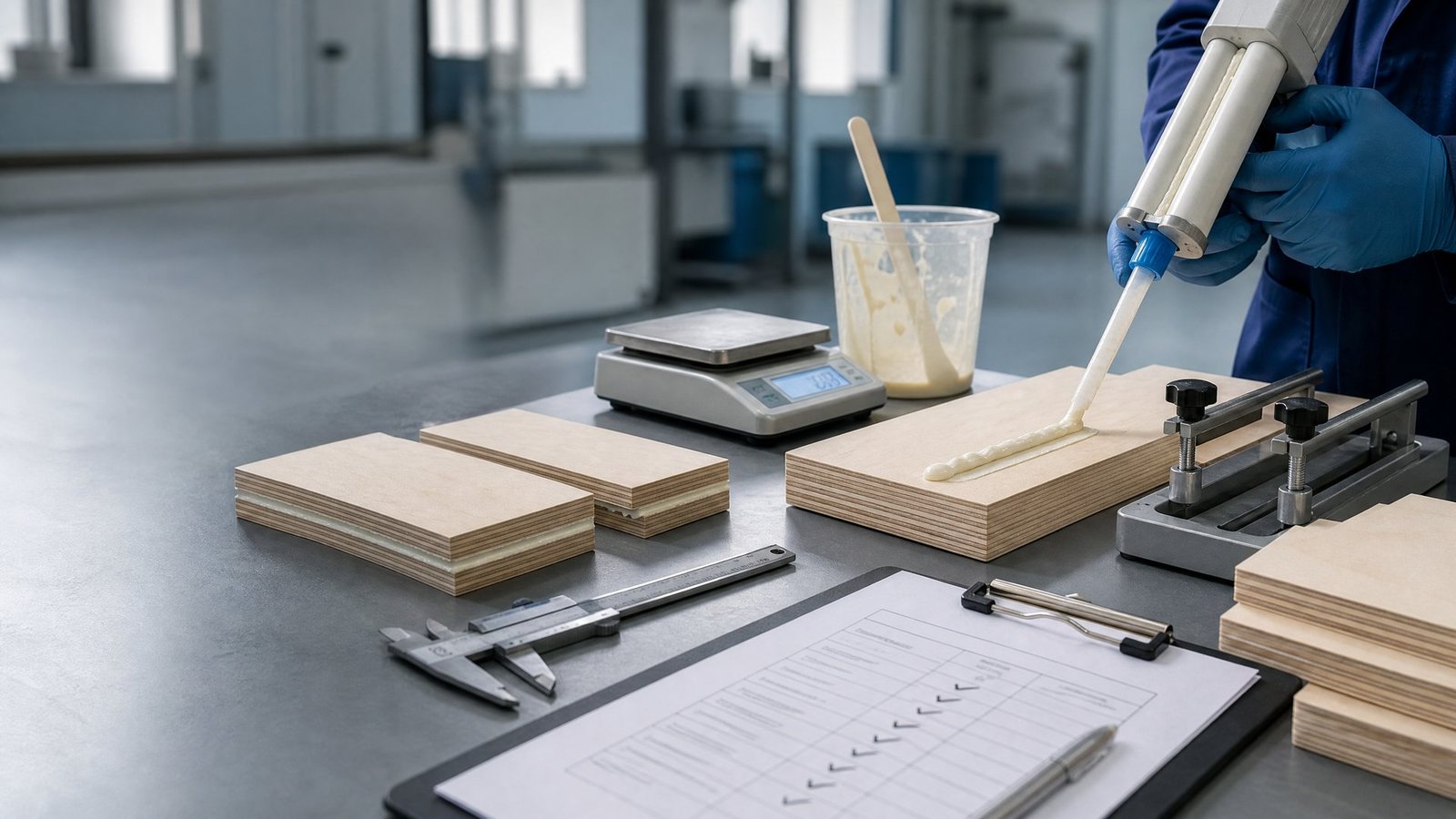
Industrial Secondary Bonding of Birch Plywood: An Adhesive-Qualification Checklist
Birch plywood can arrive with the correct grade, dimensions and panel bond, yet a downstream assembly can still fail if the secondary bonding process is not qualified. Furniture, vehicle-body, interior-fit-out and industrial-component manufacturers may bond plywood to plywood, timber, metal, laminate, foam or another substrate. Each combination creates its own surface, joint, process and service requirements.
This guide is for European procurement, process-engineering, quality and production teams. It explains how to qualify an adhesive system for bonding finished plywood components after the panel has been manufactured. It does not select a universal glue, provide structural design values or replace the adhesive supplier’s current technical data sheet (TDS), safety data sheet (SDS), application standard or engineering approval.
Nord Panels manufactures birch plywood in Kazakhstan exclusively from Kazakhstan-sourced raw materials. Buyers can review available grades and formats on the Nord Panels birch plywood page, then use the workflow below to qualify the actual secondary bond used in their own production.
1. Separate the panel bond from the fabrication bond
A plywood panel contains factory-made bonds between veneers. A manufacturer may later create a different bond when assembling cut panels into a cabinet, floor module, vehicle component or interior system. These two bonds have different materials, process controls and failure risks.
The plywood’s factory bond specification does not automatically qualify a downstream PVA, polyurethane, epoxy, hot-melt or other adhesive. Conversely, a strong secondary adhesive cannot correct an unsuitable joint geometry, contaminated surface, uncontrolled moisture condition or inadequate cure.
| Question | Factory panel bond | Secondary fabrication bond |
|---|---|---|
| Where is it created? | During plywood manufacture | In the buyer’s production process |
| What is bonded? | Birch veneers within the panel | Finished plywood surfaces or plywood plus another substrate |
| Who controls the process? | Panel producer | Component or assembly manufacturer |
| What evidence is relevant? | Panel specification and applicable panel-bond documentation | Adhesive TDS/SDS, joint design, surface preparation, process record, coupons and first-article results |
| What must be qualified? | Panel construction for the intended panel use | The actual substrate combination, adhesive, geometry, process and service environment |
Qualification principle: Approve a complete bonded-joint system, not an adhesive trade name in isolation.
2. Define the service case before asking for samples
A supplier cannot recommend a meaningful adhesive from the words “birch plywood” alone. The qualification brief should describe the two adherends, load direction, joint geometry, production rate, cure constraints, service temperature, moisture exposure, cleaning chemicals, fire or emission requirements, repairability and expected life.
The same plywood grade may require different bonding solutions in a dry furniture interior, a refrigerated vehicle, a warm equipment enclosure or an intermittently wet installation. Where the joint is safety-critical or load-bearing, the design authority must define the applicable structural requirements and approval route before testing begins.
| Qualification input | What the manufacturer should state | Why it changes the decision |
|---|---|---|
| Adherend A | Plywood grade, face, sanding state, coating or film | Determines the available bonding surface |
| Adherend B | Plywood, timber, metal, laminate, foam or other material | Controls compatibility and surface preparation |
| Load case | Shear, tension, peel, cleavage, impact, fatigue or mixed mode | Influences geometry, adhesive behaviour and test selection |
| Service environment | Indoor humidity, water contact, heat, cold, chemicals, UV or cycling | Defines conditioning and durability evidence |
| Production constraints | Open time, assembly time, press/clamp method, cure time and takt | Determines whether the process is repeatable on the line |
| Compliance constraints | Emissions, worker exposure, transport, fire, food-contact or customer rules | May exclude otherwise technically suitable products |
| Failure consequence | Cosmetic rework, production stop, functional loss or safety risk | Sets the depth of qualification and process control |
ISO 21368:2022 provides a broad framework for adhesive-user companies to define fabrication quality requirements, reporting procedures, records and risk evaluation. It is independent of adhesive type and can be adopted in full or selectively to suit the bonded structure.2
3. Freeze the plywood condition used for qualification
The test must represent production material. Record the plywood grade, face quality, nominal thickness, finish, coating, supplier lot and as-received condition. If the process bonds a sanded face, do not qualify only on a different face. If production uses cut edges, include the relevant edge construction and machining condition.
Wood, adhesive and the interphase between them act as links in one load-transfer chain. USDA Forest Products Laboratory guidance emphasizes that bonded-joint performance depends on understanding and controlling all these links rather than treating the adhesive as the only variable.4
A practical material-release record should capture:
| Plywood control | Minimum record before bonding |
|---|---|
| Product identity | Grade, thickness, format, face and purchase-order reference |
| Traceability | Pack, lot or delivery identification |
| Surface state | As supplied, freshly machined, sanded, coated or film-faced |
| Condition | Relevant temperature, humidity or moisture observations |
| Storage history | Time and conditions between receipt, machining and bonding |
| Defects at bond area | Dust, oil, release agent, scorch, loose fibres, dents or coating damage |
Do not assume that a successful laboratory sample made from freshly prepared material will reproduce a line process that stores machined parts for days. Qualification should define the maximum permitted time between surface preparation and adhesive application, together with the protection required during that interval.
4. Treat surface preparation as a controlled process
The surface-preparation instruction must be specific enough for two trained operators to produce the same result. “Clean and sand if necessary” is not a process specification.
For each adherend, define the approved preparation method, abrasive or cutter condition, target surface state, dust-removal method, allowed cleaner, drying time, handling protection and maximum delay before bonding. Verify compatibility with the adhesive manufacturer; an unsuitable cleaner can leave a residue or affect a coating.
| Surface-control point | Qualification question | Production evidence |
|---|---|---|
| Machining | Is the cutter sharp and is the surface free from glazing, burning or torn fibres? | Tool ID or condition check; visual reference standard |
| Sanding | Is grit sequence, direction and pressure controlled? | Work instruction and sample panel |
| Dust removal | Is dust removed without contaminating the surface? | Approved vacuum/air method and inspection |
| Cleaning | Is the cleaner approved for both substrate and adhesive? | TDS/SDS reference, method and drying time |
| Handling | Are prepared faces protected from oil, gloves, release agents and shop contamination? | Handling rule and protected storage |
| Time window | How long may the prepared surface wait before application? | Timestamp or batch traveller |
A change of coating, film, sanding process, cleaner or machining tool can be a requalification trigger because it changes the actual bonding surface even when the plywood product name remains unchanged.
5. Shortlist adhesives by application, not by headline strength
The initial shortlist should be based on substrate compatibility, service environment, joint geometry, process window and compliance constraints. A high value on a generic data sheet is not proof that the adhesive is suitable for the actual plywood assembly.
For non-structural thermoplastic wood adhesives, EN 204 classifies products into durability classes D1 to D4 using dry and wet bond-line strength after specified conditioning. Its scope is non-structural, does not specify bond-line temperature resistance and recognizes that special applications can require further tests.8 EN 205 provides a tensile-shear test for thin bond lines in wood and derived timber products, but it does not apply to structural adhesives or plywood manufacture and does not replace testing of the finished product.9
Therefore, a D-class statement should never be treated as universal approval for every plywood joint. Epoxy, polyurethane, acrylic, hot-melt and other systems may require different evidence. The final shortlist should be supported by the current TDS, SDS, supplier application guidance and a documented technical review.
| Supplier document | Buyer check |
|---|---|
| TDS | Approved substrates, preparation, mix ratio, spread, open time, assembly time, pressure, cure and service limits |
| SDS | Hazards, PPE, ventilation, storage, spill response and disposal controls |
| Declaration/certificate | Exact product and revision; scope and issuing body |
| Application recommendation | Actual plywood face and second substrate, not a generic “wood” statement |
| Batch documentation | Lot number, manufacture/expiry dates and storage conditions |
| Change notification | How formulation, site or critical raw-material changes will be communicated |
6. Design the joint to reduce peel and cleavage
Adhesive joints generally perform more predictably when loads are distributed over an area and directed into shear rather than concentrated at an edge in peel or cleavage. Manufacturer design guidance illustrates how overlap, flanges, tongue-and-groove or mechanical interlock can convert part of an unfavourable load into shear and enlarge the bonded area.5
This does not mean that a longer overlap always solves the problem. Stiffness mismatch, eccentric loading, bond-line thickness, edge effects and adherend deformation can still concentrate stress. The design review should identify load paths and decide whether a hybrid joint, mechanical retention or fail-safe feature is required.
| Joint-design question | Controlled response |
|---|---|
| Where does the load enter? | Mark load direction and eccentricity on the drawing |
| Is peel concentrated at an edge? | Change geometry, add a flange/radius or introduce suitable retention |
| Is bond-line thickness controlled? | Define spacers, application method or assembly pressure |
| Can squeeze-out starve the joint? | Establish target spread and minimum bond-line condition |
| Can parts move during cure? | Define fixture, clamp pressure and release time |
| Is the joint inspectable? | Identify process checks, witness coupons or destructive audit frequency |
7. Establish a measurable process window
The qualification trial should vary only planned factors and record every critical parameter. Fraunhofer IFAM notes that complete testing of every produced bond is technically impossible; quality therefore depends on correct execution of dosing, application, joining, fixing and curing.3
A controlled trial record should include adhesive identity and lot, component identity, mix ratio, mixing equipment, substrate condition, surface-preparation time, ambient conditions, application method, spread or bead geometry, open time, assembly time, pressure, fixture time, cure time and operator.
| Process parameter | Lower/upper control | Evidence method |
|---|---|---|
| Storage and shelf life | Supplier limits | Inventory and lot check |
| Mix ratio | TDS tolerance | Meter reading, weight check or equipment log |
| Application amount | Qualified range | Wet weight, bead dimensions or machine record |
| Open/assembly time | Qualified maximum | Timestamp or automated trace |
| Temperature and humidity | Qualified range | Calibrated workplace record |
| Pressure/fixture | Qualified range and duration | Press setting, clamp method or fixture check |
| Cure before handling | Minimum time/condition | Traveller release point |
| Full cure before test/use | Defined condition | Test schedule and production release rule |
Qualification should challenge credible limits, not only the easiest nominal setting. If the line can operate at two temperature extremes or two takt times, the trial plan should address those conditions or formally restrict production to the qualified window.
8. Use representative coupons and first articles
Laboratory coupons are useful for comparing options and establishing repeatability, but they must represent the real adherends, preparation and cure. ISO 4587 specifies a tensile lap-shear method for rigid-to-rigid bonded assemblies under defined specimen conditions; ISO explicitly states that the method does not provide design information.6
Record the failure pattern as well as the peak result. ISO 10365:2022 provides standardized designations for the principal failure patterns in bonded assemblies, regardless of adherend and adhesive type.7 A numerical result without failure-mode evidence can hide a change from cohesive or wood failure to interface failure.
| Qualification layer | Purpose | Typical evidence |
|---|---|---|
| Screening coupon | Remove clearly unsuitable combinations | Comparative result, visual/failure-mode record |
| Process-window coupon | Test credible process limits | Parameter matrix and repeatability |
| Conditioned coupon | Assess relevant water, heat, cold or cycling exposure | Before/after result and failure pattern |
| Representative subassembly | Include geometry, stiffness and production handling | Destructive or functional test |
| First article | Confirm production equipment, operator and documentation | Signed first-article record |
| Ongoing witness coupon | Monitor line consistency where justified | Scheduled trend and reaction limits |
Acceptance criteria should be set before testing. They may include minimum result, permitted variation, required failure pattern, dimensional condition after ageing and functional performance of the actual component. Do not retrospectively choose whichever criterion the sample happens to pass.
9. Control the first-article release
The first article demonstrates that the approved process can be executed with production materials, equipment and personnel. It should not be a hand-built laboratory exception.
A first-article dossier should connect the drawing revision, bill of materials, plywood and adhesive lots, TDS/SDS revisions, surface-preparation instruction, equipment settings, operator qualification, environmental record, cure record, coupons, finished-part inspection and approval signature.
| Release gate | Evidence required |
|---|---|
| Materials correct | Plywood and adhesive identities match the approved list |
| Documents current | Drawing, work instruction, TDS and SDS revisions verified |
| Equipment ready | Dosing, mixing, application and fixture checks complete |
| Personnel ready | Training and authorization current |
| Process within window | All recorded values meet the approved ranges |
| Test passed | Coupon/subassembly and failure-mode criteria met |
| Deviations closed | Any exception has authorized disposition |
| Traceability complete | Records link the released part to materials and process |
Any change to adhesive formulation, supplier, plywood surface, second substrate, cleaning method, tooling, application equipment, cure cycle or joint geometry should enter a documented change review. The review decides whether the existing qualification remains valid, needs partial confirmation or requires full requalification.
10. Integrate chemical safety into adhesive selection
The technically strongest option is not acceptable if it cannot be handled safely and legally in the intended plant. Procurement should obtain the current SDS and confirm worker exposure controls, ventilation, PPE, storage, expiry and waste arrangements before approving production trials.
In the EU/EEA, Commission Regulation (EU) 2020/1149 amended REACH Annex XVII for diisocyanates. Industrial or professional users of products with a total monomeric diisocyanate concentration above 0.1% by weight must complete the required training before use; suppliers must communicate the training requirement.10 Ireland’s HSA explains that training records must be maintained and renewed every five years, while Northern Ireland’s HSENI provides the same threshold and practical control framework.11
This rule does not mean that every polyurethane product has the same status. Check the exact label, SDS and monomeric content. Manufacturer guidance also notes that some low-monomer products may fall outside the training threshold.13 For Great Britain, verify the current UK REACH position and workplace controls rather than automatically applying an EU/EEA statement.
11. Define production monitoring before launch
Once qualification is complete, convert its critical variables into a short operator record and a reaction plan. A long report that never reaches the shop floor does not control the process.
| Production check | Frequency | Reaction to failure |
|---|---|---|
| Material and expiry | Every batch/shift change | Quarantine incorrect or expired material |
| Surface condition | Start-up and defined interval | Stop, reclean or remake components |
| Mix/application | Continuous or defined sample | Hold output since last acceptable check |
| Open and assembly time | Each assembly or automated trace | Segregate out-of-window parts |
| Fixture/cure | Each batch | Extend hold only if allowed by approved instruction |
| Witness coupon | Risk-based interval | Trigger containment and engineering review |
| Final visual/function check | Defined plan | Record defect and follow nonconformity process |
Trend data can reveal drift before a specification limit is crossed. Increasing interface-failure frequency, longer cure response, application-weight change or repeated surface contamination should trigger investigation even if a single coupon still passes.
12. Avoid eight common qualification errors
| Error | Why it is unsafe | Better control |
|---|---|---|
| Approving an adhesive by brand name alone | Product revision and application scope are unclear | Approve exact product, revision and supplier documents |
| Treating the panel’s internal bond as proof | It is a different joint and process | Qualify the actual secondary assembly |
| Using only pristine laboratory surfaces | Production contamination and waiting time are ignored | Reproduce real preparation and handling windows |
| Reporting only average strength | Variation and failure-mode shifts disappear | Keep individual results and ISO 10365 classification |
| Using ISO 4587 as a design allowables table | ISO states the method does not provide design information | Use it as a controlled test and obtain engineering design evidence separately |
| Treating D4 as universal approval | EN 204 has a defined non-structural thermoplastic scope | Match the standard, adhesive chemistry and end use |
| Ignoring chemical training obligations | A technically suitable process may be noncompliant or unsafe | Review SDS, threshold, training and local requirements |
| Changing surface preparation without review | The adherend interface has changed | Apply formal change control and requalification logic |
13. RFQ and trial-request wording
A buyer or manufacturer can adapt the following request:
Provide a proposed adhesive system for secondary bonding of the specified birch plywood surface to the stated second substrate. Confirm substrate compatibility, surface preparation, storage, mix ratio, application amount, open and assembly times, bond-line control, pressure/fixture requirements, cure conditions and service limits in the current TDS. Supply the current SDS and identify any industrial-user training requirement. Support a qualification plan using representative adherends, conditioned coupons, failure-mode classification, a production first article and agreed acceptance criteria. Notify us before changes to formulation or manufacturing site that could affect the qualified process.
The trial request should attach the component drawing, service environment, production takt, available equipment, target life, failure consequence and required evidence. If the joint is structural or safety-relevant, the design authority must define the applicable engineering and regulatory approval route.
14. Build the qualification around the actual panel and process
A reproducible secondary bond starts with a clear specification, representative plywood, controlled preparation, documented process limits and evidence that reflects the real assembly. Testing should support the decision, not replace process control.
Nord Panels produces birch plywood in Kazakhstan exclusively from Kazakhstan-sourced raw materials. To discuss available grades, formats and pack configuration for a qualification trial, review the birch plywood range and contact the Nord Panels team. Adhesive selection, joint design and production approval remain the responsibility of the manufacturer and its qualified technical partners for the actual application.