






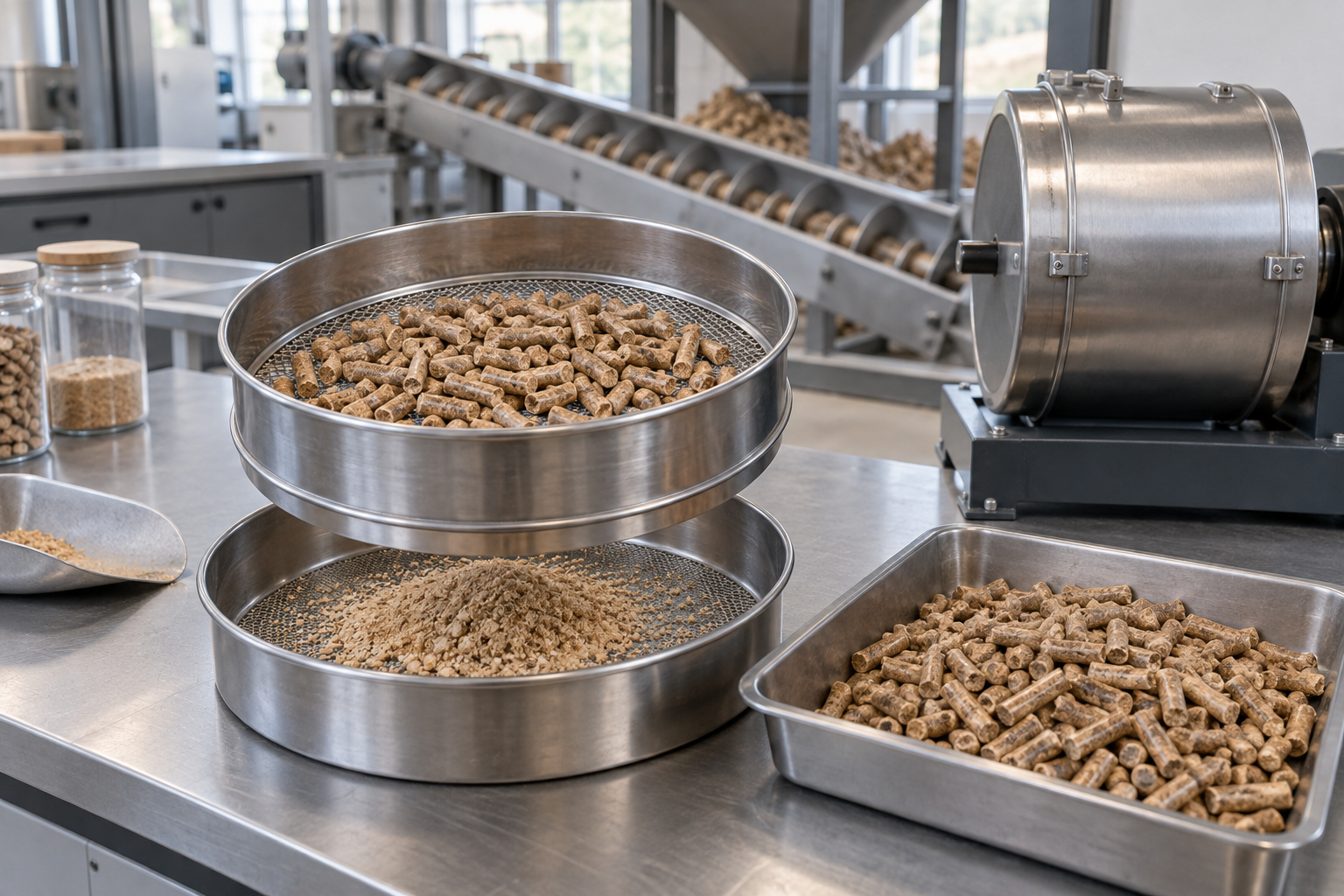
Pellets may leave a production line intact yet arrive with more dust and broken material after loading, road transport, unloading, augers or pneumatic transfer. For European buyers, the useful purchasing question is therefore not simply “Are the pellets durable?” It is: which property will be measured, by which method, at which point in the logistics chain, and who carries the risk after each transfer?
Nord Panels manufactures wood pellets in Kazakhstan using exclusively Kazakhstan-sourced raw materials. Its live wood pellet page presents 8 mm pellets and available packaging formats. The contract, however, should define the quality evidence and handling conditions required for the buyer’s own equipment and destination.
1. Define the failure mode: intact pellets becoming fines
Fines are loose particles generated when pellets chip or abrade. They can increase during repeated drops, long screw-conveyor routes, high pneumatic velocity, sharp bends, overfilled transfer points or repeated rehandling. The operational consequences may include uneven feeding, dust accumulation, more housekeeping and a higher risk of blocked or unstable dosing.
A specification should distinguish between product condition before dispatch and condition after a named handling sequence. Without that distinction, a factory sample and a delivery sample may both be valid while answering different questions.
2. Separate mechanical durability from fines content
Mechanical durability and fines content are related, but they are not interchangeable.
- Mechanical durability indicates how well pellets resist shocks and abrasion during handling and transport. The current ISO 17831-1:2025 defines the test method.
- Fines content measures the mass fraction passing through a specified sieve. ISO 5370:2023 is the current method for determining fines in pellets and replaced ISO 18846.
A durability result describes resistance under a controlled test. A fines result describes the condition of a sample at a stated point. A contract should list both separately when both matter to the receiving system.
3. Specify the method, limit and measurement point
Write each requirement as a complete clause: property, method, unit, limit, sample location and responsible party. For example, “mechanical durability tested to ISO 17831-1 on the dispatch sample” is clearer than “high durability.” Likewise, a fines limit is incomplete unless the contract says whether it applies before loading, after unloading, after pneumatic transfer or at the inlet to the buyer’s silo.
The 2025 second edition of ENplus ST 1001 can be used as a market reference: its table lists mechanical-durability and fines thresholds by class and delivery form. This reference is not a claim that Nord Panels pellets are ENplus certified. Buyers should copy neither a class nor a threshold into a contract without confirming the required certification status, delivery form and test point.
4. Map where handling can create damage
Before agreeing a limit, draw the actual material route:
- production discharge and screening;
- storage and reclaim;
- filling into bags, big bags or bulk transport;
- unloading at the destination;
- screw, elevator or pneumatic transfer;
- intermediate silo and final dosing.
Record drop heights, number of transfers, conveyor length, bend geometry, blower settings and any post-transfer screening. A good dispatch result cannot control damage caused later by unsuitable receiving equipment. Conversely, poor durability may become visible only after a realistic transfer sequence.
5. Run a controlled handling trial and set remedies
For a new route or high-volume programme, use one representative lot and take paired samples at agreed points: before loading and after the final critical transfer. Keep the same sampling plan, sample mass, test method and laboratory reporting format. This isolates the change caused by handling more effectively than comparing unrelated certificates.
The contract should also state what happens when a limit is exceeded: repeat testing of a retained sample, joint sampling, screening, price adjustment, rework, rejection or investigation of the receiving system. Define which result prevails and the time window for notification. These steps turn a quality figure into an operable commercial rule.
6. Prepare a focused 8 mm enquiry
A useful request for quotation should include:
- destination country and Incoterm;
- monthly and annual volume;
- 8 mm diameter confirmation;
- packaging and transfer route;
- boiler, burner or feeding-system model;
- requested durability method and limit;
- requested fines method, limit and measurement point;
- sampling, laboratory and retained-sample rules;
- documents required with each lot.
Send these details through the Nord Panels contact page. The supplier can then assess the requested evidence and packaging against the live 8 mm offer, while the buyer retains responsibility for confirming compatibility with the receiving and combustion system.