






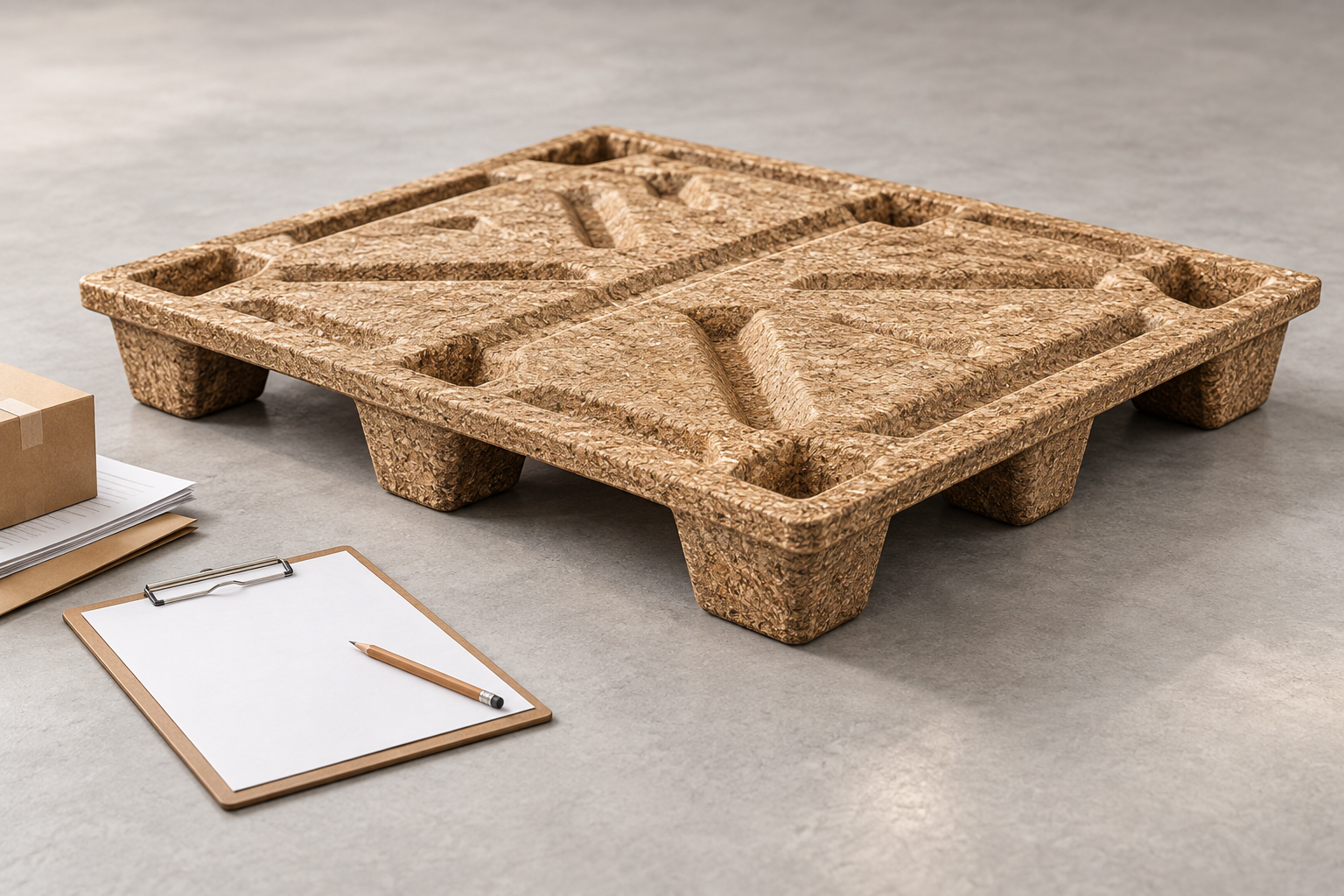
A purchase order asking for “Euro pallets” leaves an important question unanswered: does the receiver mean a footprint, or an exchangeable EPAL pallet? Resolve that ambiguity before ordering presswood pallets. A truck-sized saving can disappear if a delivery needs unexpected repalletising at the destination.
1. Separate dimensions from pallet identity
The EPAL Euro pallet has an 800 × 1200 mm footprint, a specified board-and-block construction and identifying marks. EPAL product specification.
EPAL production is subject to licensing. EPAL licensing FAQ. Our procurement conclusion: matching length and width alone cannot establish EPAL exchange status. Do not describe a moulded pallet as an EPAL exchange pallet merely because it occupies the same floor area.
Keep four separate fields in the enquiry: exact model and dimensions; suitability for the loaded handling route; receiver acceptance; and whether pallet exchange is required. An answer to one field is not approval of the other three.
2. Ask the destination, not only the carrier
Send the receiving warehouse a drawing or photograph and the proposed model reference. Ask its authorised contact whether that exact pallet is accepted for the named goods, delivery site and purchase order. A carrier agreeing to transport the load is not the same as the consignee accepting the pallet.
Check the customer's delivery instructions for Germany, Austria, Switzerland, France, Italy or the UK individually. Do not treat a country's location in Europe as proof of a common receiving policy. This is a commercial acceptance decision, not a statement that all European deliveries must use EPAL.
3. Resolve the exchange requirement in writing
If the order requires EPAL exchange, do not silently substitute presswood. Request a written amendment allowing the specified moulded pallet without EPAL exchange, or retain the required pallet type. Silence is not a useful release criterion.
For an agreed non-exchange delivery, record who owns the empty pallet after unloading, whether collection is expected, and which party bears any agreed handling charges. Keep this agreement with the delivery booking. Acceptance for one customer or shipment should not automatically become approval for another.
4. Confirm the actual handling route
Ask the receiver to review fork access, pallet-truck use, conveyor transfer points and any planned rack support against the exact pallet drawing and load. Do not transfer the performance of a conventional pallet to a moulded design solely on footprint.
Where suitability remains uncertain, propose an agreed sample trial with the receiving site's technical team before the series order. This step concerns compatibility of the proposed application; it does not replace the site's operating procedures or establish a universal load rating.
5. Put the decision into the order
Use an order note such as: “Model [reference], [dimensions], for [goods and site]; receiver approval [name/date/reference]; supplied without EPAL exchange; empty-pallet arrangements [agreed terms].” This is suggested purchasing wording, not a standardised certificate.
Before release, compare the purchase order, pallet specification and delivery booking. If one still says “EPAL exchange” while another names a presswood pallet, resolve the conflict before dispatch. Record any repalletising plan and responsibility rather than leaving that decision to the unloading crew.
6. Request a model-specific proposal
Nord Panels manufactures in Kazakhstan using exclusively Kazakhstan-sourced raw materials. Its presswood pallet range includes a 1200 × 800 mm format.
Send the receiving requirements, goods description and handling route to Nord Panels. Request the exact model drawing and relevant supporting documentation. The proposal should address the agreed delivery route without implying EPAL licensing or automatic entry into an exchange pool.
Sources checked on 13 September 2026. The cover is an illustrative scene, not evidence of certification or customer approval.