






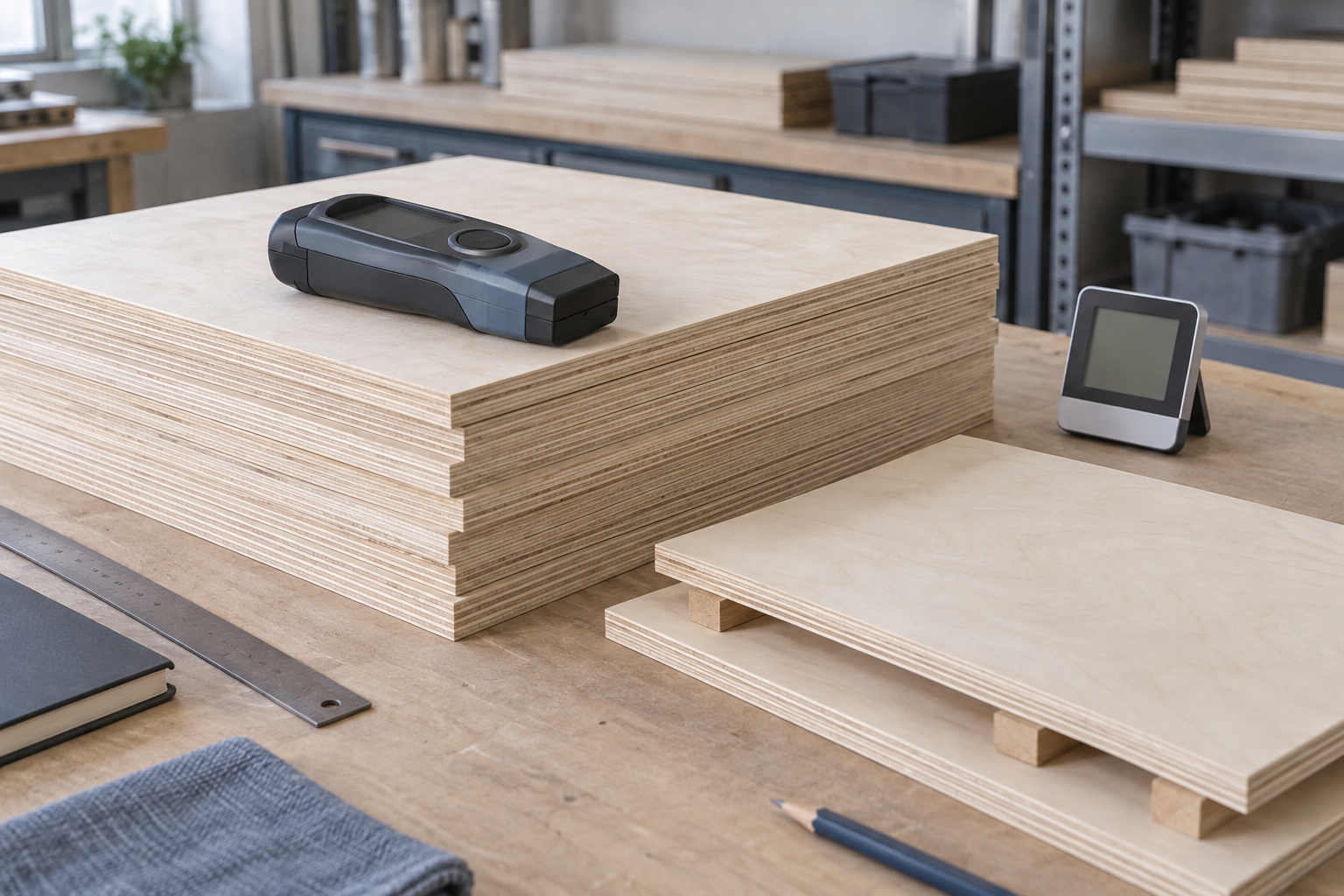
Moisture discussions often begin too late—after panels have been cut, bonded, coated or assembled. For furniture and component buyers, the useful question is not whether one handheld reading looks acceptable. It is whether the delivered lot, the measuring method and the production environment have been controlled well enough for a release decision.
1. Separate a reference method from a spot reading
EN 322 specifies a method for determining the moisture content of test pieces from wood-based panels. Its result may be used to estimate panel moisture content in conjunction with EN 326-1. EN 326-1 covers sampling, cutting test pieces, and expressing and presenting results so that panel properties can be assessed.
That scope matters. A quick reading on one face is a screening observation, not automatically the same result as a controlled test on representative pieces. State in the purchase specification whether the required evidence is a supplier report, an incoming-screening record, a reference-method result, or a combination. Cite the edition and do not reproduce a standard's limits from an uncontrolled summary.
2. Define the receiving and process environments
Record where the pack was stored, when it was opened, and the air temperature and relative humidity at receipt and at the processing area. Note any condensation, wet packaging or unusual surface readings before the material is mixed with released stock.
Do not choose a universal percentage or a fixed conditioning time from an unrelated project. The acceptable release range should be set by the product and process owners for the intended machining, adhesive, coating and end-use system. The measurement device, settings, locations and acceptance rule must be written down before inspection.
3. Build a representative moisture map
Identify the delivery lot and select panels across more than one pack position rather than taking repeated readings from the easiest top sheet. Use a consistent face, distance from edges and measurement pattern. Keep the actual instrument model, calibration status and any material or density setting in the record.
Handheld meters can be useful for locating differences, but their readings depend on the instrument, method and settings. If a result is close to the release boundary or conflicts with visible condition, use the agreed reference procedure or laboratory route before accepting or rejecting the lot. Preserve sample identity so the result can be linked to the pack and order.
4. Condition to a verified state, not to a clock
If panels need to equilibrate with the processing area, define how packs are opened, supported and separated, and protect them from liquid water, dirty floors, heaters and direct sun. Spacers may help air reach surfaces when the process owner specifies them, but the arrangement must keep panels flat and safely supported.
“Wait 48 hours” is not a universal acceptance criterion. Panel thickness, pack construction, air movement and the difference between storage and production environments all influence the change. Recheck at agreed intervals and release only when the documented measurements meet the project's rule and are sufficiently stable for the next operation.
5. Use a pre-production release gate
Link the moisture record to the first production operation. Before CNC cutting, laminating, coating or assembly, confirm the lot identity, environmental record, measurement map, deviations and disposition. When adhesives or finishes are involved, use the process supplier's current technical instructions and a representative trial; moisture screening alone does not qualify a bond or finish.
Suggested order wording: “Lot identification and receipt environment recorded; moisture assessment method [method/edition]; instrument and settings [details]; sampling locations [plan]; agreed release range and decision rule [project requirement]; conditioning and recheck procedure [details]; authorised disposition [role].” This turns a vague instruction to acclimatise plywood into an auditable decision.
6. Send a process-specific enquiry
Nord Panels manufactures in Kazakhstan using exclusively Kazakhstan-sourced raw materials. Review the birch plywood range, then send the panel construction, thickness, format, quantity, destination, planned operation and requested moisture documentation to Nord Panels.
Ask what order-specific information can be supplied and agree the receiving protocol before shipment. The cover is an illustration, not a test certificate or measured result. Sources checked on 16 September 2026.