






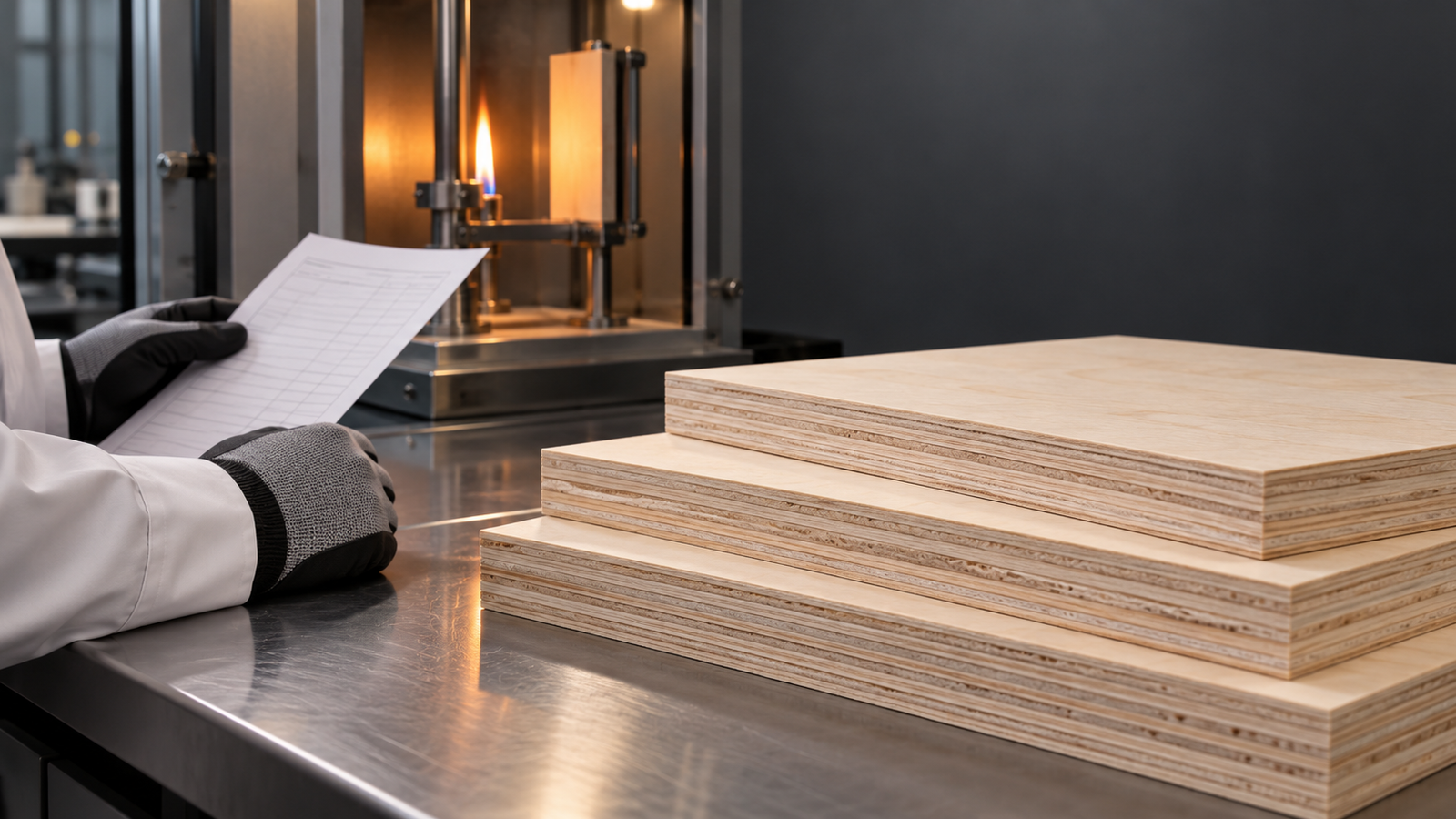
A fire-class request should never be reduced to “send fire-rated plywood.” For European procurement, the buyer must connect the declared reaction-to-fire performance to the exact panel, thickness, surface, mounting method and intended use. A class quoted for another construction may not cover the product being ordered.
Nord Panels manufactures birch plywood in Petropavlovsk, Kazakhstan, using Kazakhstan-sourced raw material. The checklist below helps buyers define the evidence needed before approving a batch.
Reaction to fire is not the same as fire resistance
Commission Delegated Regulation (EU) 2016/364 sets the European reaction-to-fire classification system for construction products. For products other than floorings, the main classes run from A1 to F. Some classes also carry smoke and flaming-droplet indicators, written as s1–s3 and d0–d2.
These symbols describe how a product contributes to fire under defined test conditions. They do not by themselves state how long a wall, floor or other complete building element will maintain load-bearing capacity, integrity or insulation. That separate question concerns the fire resistance of the assembled element.
Flooring classifications also use a separate “fl” notation. A flooring result should not be treated as an automatic substitute for a wall or ceiling classification.
Why the exact panel and installation matter
A classification is linked to the tested or assessed product and its field of application. Buyers should check whether the evidence covers:
- the plywood construction and declared product type;
- the ordered thickness and relevant density range;
- uncoated, film-faced, mesh-faced or otherwise treated surfaces;
- any fire-retardant treatment and its application;
- the substrate, fixing method and orientation;
- an air gap or no air gap behind the panel;
- joints, exposed edges and other installation conditions.
A familiar class designation is not enough if the report does not cover the ordered configuration. Likewise, “wood-based panel” is too broad for a purchase specification.
Seven items to request before approval
1. Intended use and destination
State whether the panel will be used as an interior lining, wall or ceiling component, flooring, transport fit-out, furniture part or another application. Also identify the destination country, because project and national building rules may differ.
2. Exact product identification
The commercial name, plywood type, thickness, face treatment, adhesive system and any fire-retardant treatment should match the order and the supporting documents.
3. Classification report
For a tested classification, request a report based on EN 13501-1 and check the stated class, product description, report holder and field of application. Do not copy a class from a brochure without the underlying scope.
4. Test or assessment basis
Ask which test reports, extended-application rules or “classification without further testing” conditions support the result. EU rules provide specific classification-without-testing routes for certain wood-based panels, but only when all stated conditions are met.
5. Declaration and CE documentation where applicable
Where the product and intended use fall under a harmonised construction-products route, review the Declaration of Performance and CE information together with the classification evidence. The European Commission notes that the 2011 and 2024 Construction Products Regulations will coexist during a transition, so buyers should verify the route that applies to the product at the time of supply.
6. Report validity and traceability
Record the issuing body, report number, issue date, revision and product reference. Confirm that the document has not been superseded and that the supplier is entitled to use it for the offered product.
7. Installation conditions
Put critical mounting conditions into the project specification and installer instructions. A valid laboratory classification can be misapplied on site if the substrate, cavity, fixing or orientation changes.
Suggested purchase-order wording
“Supplier shall provide reaction-to-fire classification evidence valid for the exact ordered plywood, declared intended use and mounting configuration. Any change in thickness, face treatment, fire-retardant treatment, substrate, air gap or fixing method requires documented buyer approval before shipment.”
This sentence should be adapted by the project’s fire engineer or compliance specialist. It is not a substitute for national building rules.
Incoming-document check
Before releasing the lot, compare the delivery labels and packing list with the approved document set. Check product name, thickness, surface, batch reference and document revision. Quarantine unexplained deviations until the supplier confirms whether the classification still applies.
What to send Nord Panels with your enquiry
For a useful technical review, send the destination market, end use, required class, panel thickness, surface type, mounting method, substrate and whether an air gap is planned. See the birch plywood range and contact Nord Panels with the project specification. No reaction-to-fire class should be assumed until it is supported for the exact product and application.
Official references
- Commission Delegated Regulation (EU) 2016/364: reaction-to-fire classification
- Commission Decision 2003/43/EC: classes for certain wood-based panels
- European Commission: Construction Products Regulation overview
The legal and technical route must be confirmed for the specific product, project and destination.