






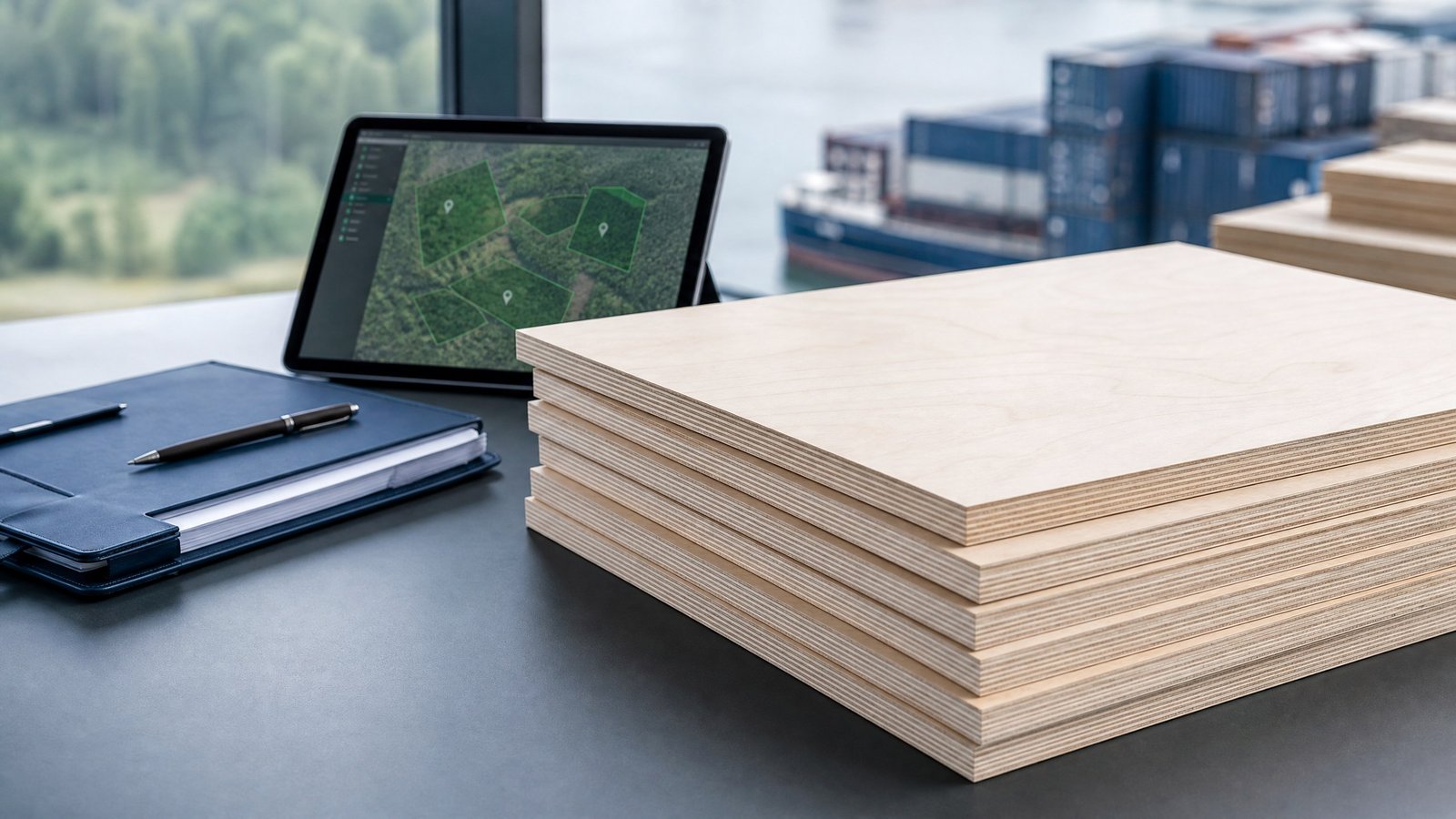
Kazakhstan-only materials: Nord Panels manufactures in Kazakhstan and uses exclusively raw materials sourced in Kazakhstan. No imported raw material is used for the products described in this article.
For an EU importer, EUDR preparation starts before the purchase order, not when the truck or container reaches customs. Birch plywood sits within HS/CN heading 4412 in Annex I of the EU Deforestation Regulation. The first EU-established business that makes goods supplied by a non-EU company available on the Union market is treated as the operator and must have the required due-diligence outcome in place before import clearance.1
As of 20 August 2026, the principal application date is 30 December 2026 for large and medium operators. Micro and small operators generally follow on 30 June 2027, while micro and small operators already covered by the EU Timber Regulation are included from 30 December 2026.2 These dates create a preparation window, not a reason to postpone supplier-data testing.
Procurement rule: Do not ask only whether plywood is “EUDR compliant.” Ask whether the data for the exact product, wood source and order can be connected from the harvesting plots to the panels, quantity and shipment covered by your due-diligence file.
Is birch plywood covered by EUDR?
Annex I lists 4412 — plywood, veneered panels and similar laminated wood under the relevant commodity “wood.”1 The precise CN subheading still matters for the customs declaration, so the importer or customs representative should confirm the code for the exact construction, outer ply and finish rather than copying a generic code from a supplier brochure.
A product in scope may be placed on the EU market only when three conditions are met: it is deforestation-free; it was produced in accordance with the relevant legislation of the country of production; and it is covered by the required due diligence statement or simplified declaration.1 For wood, “deforestation-free” includes both no deforestation after 31 December 2020 and no forest degradation caused by harvesting after that cut-off date.1
| Purchasing question | What the buyer should establish | Why it matters |
|---|---|---|
| Is the product under heading 4412? | Obtain the proposed CN code and a technical product description; validate the final classification with the customs function. | EUDR scope is defined through Annex I codes, while the exact customs subheading depends on the product. |
| Who first places it on the EU market? | Identify the EU-established legal entity acting as importer/operator, including its EORI and compliance owner. | A non-EU supplier can provide evidence, but the EU operator retains regulatory responsibility. |
| Which wood and plots are in this order? | Link species, harvesting plots, production dates and quantities to the order or lot. | Generic factory or country statements do not establish plot-level traceability. |
| Is the evidence ready before customs filing? | Set an internal release gate before the customs declaration is lodged. | The DDS reference or applicable declaration identifier must be available for the import declaration.3 |
Who is responsible when buying from Kazakhstan?
Nord Panels manufactures in Petropavlovsk, Kazakhstan. When a legal person established outside the Union supplies an in-scope product, the first EU-established person that makes that product available on the market is deemed to be the operator.1 In a typical direct import, this is therefore an obligation for the EU importer, not a responsibility that can be transferred by writing “supplier EUDR compliant” on the purchase order.
The supplier’s role remains commercially essential. Without reliable upstream records, the operator cannot complete its own file. Your contract should therefore define which order-linked data must be delivered, in what format, at which milestone, and what happens if the data fail validation.
The eight-field supplier data pack to request
Article 9 requires operators to collect, organise and retain information supported by evidence for five years.1 Translate that legal list into a practical RFQ schedule rather than leaving it as a broad compliance clause.
| Data field | Minimum procurement specification | Acceptance check before shipment |
|---|---|---|
| Product identity | Trade name, plywood type, construction/finish and proposed HS/CN code. | Description agrees across quotation, invoice, packing list and compliance file. |
| Wood species | Common name and full scientific name for every wood species used. | Scientific names are present and consistent across the lot file. |
| Quantity | Net mass in kilograms and any applicable supplementary unit; also retain commercial sheet/pack quantities. | DDS quantity logic can be reconciled to the PO and customs documents. |
| Country of production | Country where the relevant wood was produced, not only the country where the panel was pressed or shipped. | Country values are consistent with plot and legality records. |
| Production timing | Harvest or production date, or an appropriately defined time range, for the wood linked to the order. | Dates are order-linked and fall within the evidence period. |
| Plot geolocation | Coordinates for every plot from which the wood in the product was produced; polygons for plots over four hectares. | File opens correctly, coordinates are plausible and no order volume is left without plot coverage. |
| Supply-chain parties | Name, postal address and email for the supplying businesses; maintain onward-customer data as required. | Legal names match contracts and shipment documents. |
| Substantive evidence | Verifiable evidence that the product is deforestation-free and that production complied with relevant laws in the country of production. | Evidence is current, linked to the source and sufficient for the operator’s documented conclusion. |
The law defines geolocation as latitude and longitude using at least six decimal digits. For non-cattle commodities produced on plots larger than four hectares, the perimeter must be described by polygons.1 A spreadsheet containing a single factory pin is therefore not equivalent to the harvesting-plot data required for wood.
How to test geolocation before approving the order
A geolocation file can be formally complete yet commercially unusable. Procurement, sustainability and customs teams should run the same acceptance test before the first shipment sample and again whenever the source set changes.
First, confirm coverage: every wood source feeding the purchased lot must be represented. Second, confirm geometry: polygons must open without errors, must not sit in water or an obviously unrelated urban area, and should not overlap in impossible ways. Third, confirm linkage: the plot identifiers must connect to the species, harvesting period, supplier and quantity records. Finally, confirm change control: substitution of veneer, logs, harvesting areas or upstream suppliers should trigger a new review before the affected goods are released.
Satellite or map screening can support the file, but the operator still needs adequately conclusive and verifiable evidence. The European Commission describes due diligence as information collection, followed where required by risk assessment and risk mitigation; it is not a fixed tick-box certificate.3
Kazakhstan is currently low risk — what does that change?
The European Commission’s current country classification lists Kazakhstan as low risk.4 That may allow simplified due diligence where the legal conditions are satisfied. It does not remove Article 9 information collection, plot geolocation, legality evidence or record retention.1
Before relying on the simplified route, the operator must still assess supply-chain complexity and the risk of circumvention or mixing with products of unknown origin or with products from standard- or high-risk countries. If relevant information or a substantiated concern indicates possible non-compliance or circumvention, the operator must complete the full risk-assessment and mitigation process.3
| Low-risk sourcing may simplify | Low-risk sourcing does not remove |
|---|---|
| The Article 10 risk assessment and Article 11 mitigation steps, if all conditions for simplified due diligence remain satisfied. | Product, species, quantity, production country, plot geolocation, production timing, supplier and legality information. |
| The depth of routine risk work where no mixing, circumvention or contrary information is identified. | The operator’s responsibility, documentary linkage to the order and the pre-import declaration workflow. |
| The competent authority’s risk-based control profile. | Separate customs classification, origin, sanctions, anti-dumping and trade-defence checks. |
FSC documentation is useful, but it is not the EUDR file
Certification and third-party verification can provide complementary evidence in an EUDR assessment, provided the information meets the regulation’s requirements.1 A chain-of-custody certificate may help assess control systems, but it does not by itself supply every plot coordinate, production date, species record, legality document or order-specific quantity required by Article 9.
Use certificates as one evidence layer. Check the certificate holder, scope, validity, product claim and transaction linkage, then reconcile those details with the EUDR data pack. Avoid contract language that treats “FSC certified” and “EUDR complete” as interchangeable conclusions.
Keep EUDR separate from customs, sanctions and anti-dumping controls
This distinction is particularly important in a low-risk EUDR country: low deforestation risk does not mean low risk for every other legal regime. Do not use an EUDR country category as a substitute for customs advice.
RFQ wording buyers can adapt
EUDR data and cooperation requirement — The supplier shall provide, for the products and quantities quoted, an order-linked data pack sufficient to support the buyer’s obligations under Regulation (EU) 2023/1115. The pack shall include the product description and proposed HS/CN code; common and scientific names of all wood species; net quantity; country of production; harvesting/production date or time range; geolocation of all production plots in an agreed machine-readable format; supplier-chain identification; and verifiable evidence of deforestation-free and legal production. The supplier shall notify the buyer before any change to wood source, plot set, species, upstream supplier or production linkage. Acceptance of documents does not transfer the EU operator’s legal responsibility, and shipment release remains subject to the buyer’s validation.
Treat this as a procurement starting point, not legal advice. Align the final clause with your operator role, company size, Member State competent authority, Incoterms, data-protection rules and customs process.
A practical pre-shipment release gate
| Gate | Evidence owner | Release criterion |
|---|---|---|
| Scope and role | Procurement plus customs | Product code and EU operator are documented. |
| Source data | Supplier plus sustainability team | Species, production country, dates and all plot files are complete and order-linked. |
| Legality | Supplier plus compliance team | Relevant production-country evidence has been reviewed and exceptions are resolved. |
| Traceability | Quality or supply-chain team | PO, lot, production, plot, pack and shipment records reconcile. |
| Risk route | EUDR compliance owner | Simplified or full due-diligence route is documented, including any concern or mixing assessment. |
| Declaration | EU operator or authorised representative | DDS or applicable declaration has been submitted in the live EUDR Information System and the reference is available before customs filing.6 |
| Separate trade controls | Customs or legal team | Origin, sanctions, duties and trade-defence treatment have been cleared independently. |
EU, UK, Switzerland and other European destinations
This checklist addresses goods placed on the EU market. It should not be read as a statement of UK, Swiss or EEA domestic law. A buyer in the United Kingdom or Switzerland should check the rules of its own destination market; EUDR still becomes relevant if that supply chain later places the covered plywood on the EU market. Buyers serving Iceland, Liechtenstein or Norway should verify the applicable EEA incorporation and national implementation rather than assuming the EU timetable without checking.
For groups buying into several countries, place a destination-market field at the start of the RFQ. That prevents an EU due-diligence workflow from being copied inaccurately into every European order, while ensuring that EU-bound quantities receive the necessary data and declaration control.
Preparing a Nord Panels plywood enquiry
Review the current Nord Panels birch plywood range and send an application-specific enquiry through the contact page. State the panel construction, face grade, bonding, thickness, format, quantity, destination and Incoterms, then add the EUDR data schedule your EU operator requires.
Because Nord Panels manufactures in Kazakhstan, keep the wording precise: request evidence for the actual wood sources and order; do not infer a European factory, European warehouse or local stock position. Before contracting, agree which source, legality and geolocation records can be delivered, how they will be linked to the shipment, and who will resolve validation exceptions.
Conclusion
A robust EUDR purchasing process turns a broad sustainability promise into an order-level evidence chain. For birch plywood, the decisive questions are not only where the panel was pressed, but which wood species were used, where the trees were harvested, when production occurred, which laws applied, how the evidence links to the quantity, and whether the EU operator can reach a documented conclusion before customs filing.
Start with a pilot data pack before the first in-scope shipment. Test the plot files, reconcile quantities and parties, document whether simplified due diligence is justified, and keep customs and sanctions controls separate. That work gives the buyer a specification it can audit—and gives the supplier a clear list of what must be delivered with the order.
This article provides general procurement information and is not legal or customs advice. Confirm obligations for your legal entity, product code, destination and transaction with qualified advisers and the competent authorities.