






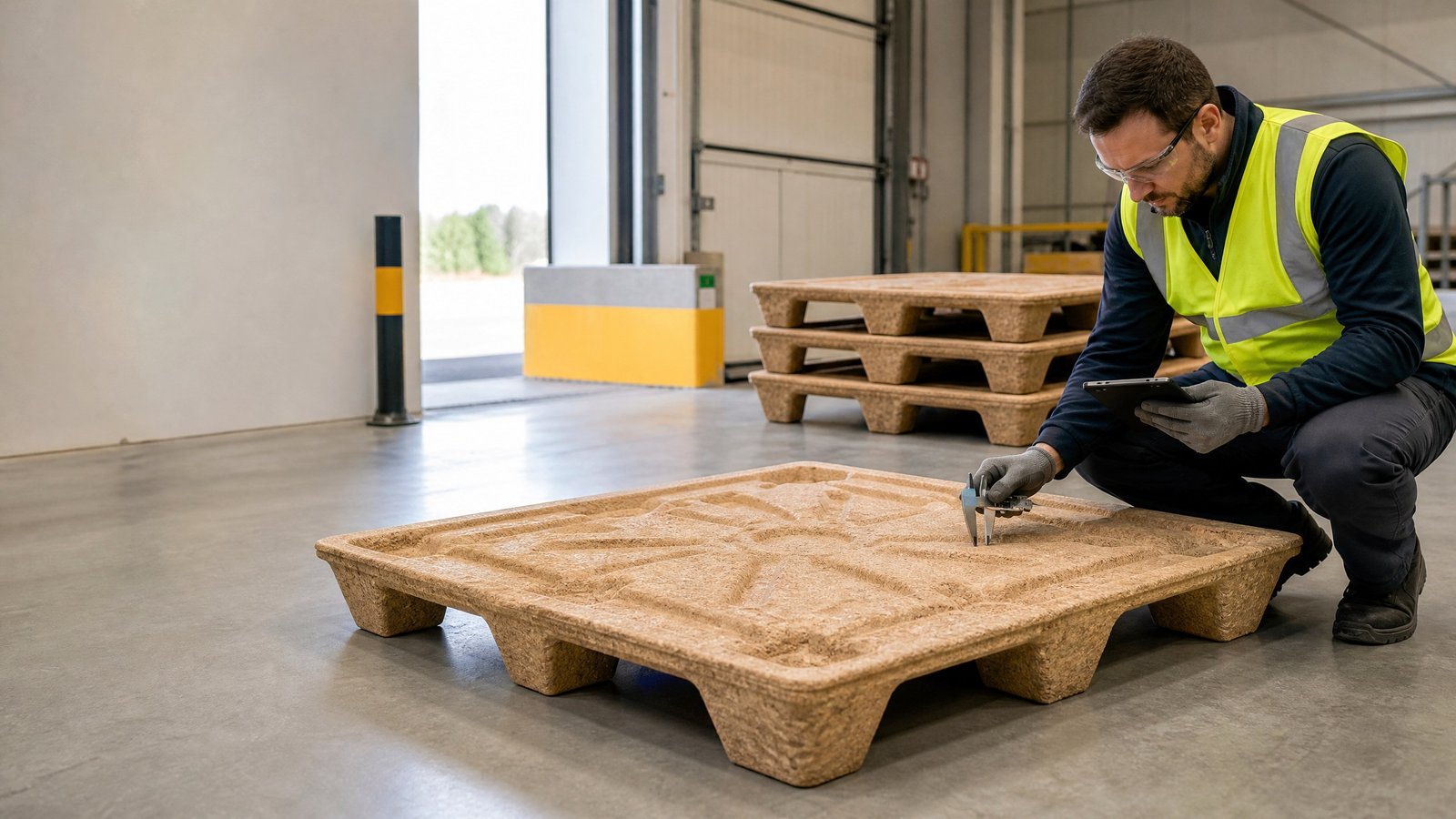
Presswood Pallet Incoming Inspection: A Buyer’s Lot-Release Checklist
A presswood pallet may arrive with a specification, a supplier test report and consistent moulded geometry, but the receiving site still needs a controlled way to decide whether the delivered lot can be released. Incoming inspection is the link between the purchase order and safe operational use. It confirms identity, quantity, condition and selected dimensions; it does not recreate a laboratory qualification programme at the warehouse door.
This guide is for procurement, supplier-quality, warehouse, logistics-engineering and health-and-safety teams in the EU, EEA, United Kingdom, Switzerland and other European markets. It shows how to turn a pallet specification into a proportionate receiving plan while keeping design qualification, routine lot inspection and in-use checks clearly separated.
1. Separate design qualification from lot acceptance
ISO 8611-1:2025 describes test methods for new flat pallets, including bending, forklift, compression, stacking, impact, friction and slip tests. It also explains that a nominal load is not the same as an actual payload and that maximum working load depends on the known payload, its distribution, stabilisation and the support condition.[1] ISO 8611-2:2025 sets performance requirements and helps select tests for different handling environments, while ISO 8611-3 addresses maximum working load for known payloads.[2] [3]
Those standards support pallet design qualification and performance evidence. Routine incoming inspection has a different purpose: confirming that the delivered lot matches the approved product and has not been damaged, contaminated, mixed or changed. A buyer should not infer a working load from appearance alone, and a supplier’s type-test report does not remove the need to inspect delivered pallets.
| Control layer | Primary question | Typical evidence |
|---|---|---|
| Design qualification | Is this pallet design suitable for the defined payload and handling environment? | ISO 8611 test report, payload description, support condition, intended-use statement |
| Supplier approval | Can the supplier reproduce the approved design consistently? | Approved drawing, material declaration, process information, sample approval, change-control agreement |
| Incoming lot inspection | Does this delivery match the approved specification and arrive in acceptable condition? | Purchase order, delivery note, lot identity, sampling record, inspection results, disposition |
| Pre-use inspection | Is this individual pallet still safe and fit for the intended task? | Operator check, damage segregation, withdrawal record |
2. Write the acceptance specification before the truck arrives
The UK Health and Safety Executive’s pallet guidance says that good communication between manufacturer and user is essential. The manufacturer needs to understand the load, load distribution, environment, handling equipment, racking, stacking, transport and reuse conditions.[4] These are therefore purchasing inputs, not details to discover after a delivery fails.
A practical specification should identify the exact model and drawing revision, nominal footprint and height, four-way entry requirements, approved colour or finish if relevant, agreed unit-weight range, intended payload, load distribution, support condition, handling equipment and permitted environment. It should also list the documents required with each delivery and define which changes require written buyer approval.
| Purchase-specification field | What the buyer should define |
|---|---|
| Product identity | Model, drawing or specification revision, footprint, height and pallet type |
| Intended use | Floor, stacking, conveyor, pallet truck, forklift, beam rack or other support condition |
| Payload | Mass, distribution, package contact points, restraint method and centre-of-gravity considerations |
| Critical interfaces | Fork openings, conveyor/roller geometry, rack support, automated-system clearances |
| Condition criteria | Cracks, flaking, wear, swelling, blistering, contamination, deformation and blocked openings |
| Documentation | Delivery note, lot/batch reference, origin documents and agreed technical records |
| Sampling plan | Lot definition, selection method, defect classes, sample size and acceptance/rejection numbers |
| Change control | Material, binder, mould, geometry, process, manufacturing site or test-report changes requiring notice |
The acceptance criteria should use measurable language. “Good quality” is not an inspection rule; “no crack crossing a load-bearing leg” or “all specified fork openings unobstructed” can be applied consistently.
3. Establish lot identity and document control first
Before opening a stack, reconcile the purchase order, delivery note, quantity, model and lot or batch reference. Photograph the vehicle condition, stack condition and identification labels where this is part of the buyer’s procedure. Record the arrival date, supplier, production reference, inspector and storage location.
Documents should be checked for relevance, not merely collected. A test report should identify the pallet design tested, test edition, date, laboratory or test body, payload and support conditions. A generic report for a different geometry or an old design revision should not be treated as evidence for the delivered model. If origin or phytosanitary status is material to the shipment, the document pack should identify the actual product supplied.
The European Commission states that EU wood-packaging requirements based on ISPM 15 do not apply to packaging made entirely from processed wood produced using glue, heat and pressure.[5] The IPPC likewise distinguishes wood packaging made from raw wood from processed material that is manufactured so it is free from pests.[6] Receiving teams should therefore verify that the delivery is the approved one-piece processed-wood design and that no unapproved solid-wood component has been introduced. The exemption does not replace structural, dimensional or condition checks.
4. Use a written sampling plan, not convenience sampling
For a recurring series of lots, ISO 2859-1:2026 provides AQL-indexed single, double and multiple sampling schemes for inspection by attributes, together with switching rules between normal, tightened and reduced inspection.[7] It can make inspection effort more consistent, but it does not supply a universal pallet sample size. The buyer must define the lot, inspection level, AQL, defect classes and acceptance/rejection numbers for the actual risk and supply arrangement.
AQL should not be presented as a promise that a particular shipment contains an “allowed percentage” of defects. It indexes a sampling system across a continuing series of lots. Critical safety defects may require a much stricter rule than cosmetic defects, including zero acceptance in the inspected sample where the buyer’s risk assessment and contract require it.
Samples should be selected across the delivery rather than from the most accessible top layer alone. A balanced selection can include different stacks, positions, packaging units and, when identifiable, production times. If a delivery includes mixed models or visibly different production groups, those groups should not be combined into one artificial lot.
5. Create a controlled receiving zone
The inspection area should keep unchecked pallets separate from released stock. It needs adequate lighting, a stable floor, safe access to the sample, calibrated measuring tools where required and a clear route for moving rejected units without returning them to usable inventory.
Inspectors should not stand beneath unstable stacks or climb them. Stacks should be broken down with suitable handling equipment and trained operators. The HSE notes that pallet accidents can be serious and that unsafe stacking, unsuitable equipment, mixed pallet sizes and continued use of damaged pallets are recurring causes.[4]
A simple status system prevents accidental use:
| Status | Meaning | Control |
|---|---|---|
| Hold | Delivery received but not yet accepted | Physical segregation and system block |
| Released | Required checks passed | Release record and identified storage location |
| Conditional release | Written, authorised concession for a defined use | Quantity, use limit, duration and approver recorded |
| Quarantine | Result unclear or investigation needed | No use until decision |
| Rejected | Lot or units do not meet the agreed criteria | Mark, isolate and arrange return or approved disposal |
6. Inspect pressed-wood-specific damage modes
HSE guidance gives specific examples for pressed-wood pallets: check for cracking, flaking or wear; local swelling or blistering that indicates water absorption; damage from excessive heat, cold or chemical spills; and debris, damage or blocked drainage holes in hollow supports.[4] These points can form the core of a visual inspection, extended for the buyer’s design and application.
| Inspection area | What to look for | Typical disposition question |
|---|---|---|
| Deck | Through-cracks, flaking, delamination-like surface loss, deep indentation or distortion | Could the defect affect load support, package stability or handling? |
| Legs/supports | Cracks, chipped load-bearing edges, crushing, permanent deformation or missing material | Is the support geometry intact for the intended handling and rack condition? |
| Fork entry | Obstruction, impact damage or narrowed entry path | Can approved equipment enter squarely without striking the pallet? |
| Surface | Chemical residue, oil, odour, embedded debris, mould-like growth or unacceptable dirt | Is the pallet clean and suitable for the product environment? |
| Moisture evidence | Local swelling, blistering, softness, staining or wet packaging | Must affected units be isolated and investigated? |
| Geometry | Twist, bow, rocking on a flat reference or asymmetric nesting | Could the pallet jam, destabilise a load or fail an automation interface? |
| Openings/drainage | Blockage, trapped material or damage | Are designed openings functional and clean? |
A photograph should show the defect, its location and scale. Do not “repair” a one-piece moulded pallet by improvised fastening, filling or patching unless an approved manufacturer procedure explicitly permits it.
7. Measure only what the application makes critical
Not every dimension needs to be measured on every sampled pallet. Select characteristics that control compatibility: overall length, width and height; fork opening width and height; leg location; critical deck contact points; nesting pitch; or rack-bearing geometry. The approved drawing should define the datum and tolerance.
A go/no-go gauge or master fixture can be more reliable than repeated tape measurements for a high-volume interface. For conveyors or automated systems, a dry fit with an approved fixture can reveal protrusions, rocking, blocked entry and geometry drift. A live-system trial should be controlled and must not expose people or equipment to an unqualified pallet.
Unit weight can be a useful trend signal when measured on a suitable scale under agreed conditioning, but it is not a substitute for structural testing. A shift in weight may trigger investigation into moisture, material distribution or process change; it does not by itself prove acceptance or rejection.
8. Keep performance claims tied to the use case
ISO 8611-1 stresses that nominal load is not a payload. The maximum working load varies with the payload type, distribution, stabilisation and support system.[1] A receiving team should therefore compare the delivery with the approved model and report rather than treating one headline number as valid for floor stacking, forklift handling and beam racking alike.
The qualification pack should state whether the intended mode includes racking, stacking or handling without either. It should also define whether the payload is uniformly distributed or concentrated. If the buyer changes the load pattern, package footprint, rack span, conveyor support or handling method, the original approval may no longer answer the new question.
Incoming inspection may include a simple function or fit check agreed in the specification. Destructive bending, impact or maximum-working-load tests belong in a planned qualification or verification programme with suitable equipment, competent personnel and defined test conditions.
9. Classify defects before deciding the lot
Defect classes should be agreed before inspection. A practical model separates critical defects that could create an immediate safety or functional hazard, major defects that materially reduce fitness for intended use, and minor defects that do not prevent use but exceed an agreed appearance or workmanship limit.
| Example classification | Buyer-defined examples | Possible lot action |
|---|---|---|
| Critical | Structural crack in a load-bearing leg, severe deformation, incompatible fork entry, hazardous contamination | Stop, quarantine and escalate; apply the contracted critical-defect rule |
| Major | Out-of-tolerance critical dimension, significant swelling, blocked functional opening, model/document mismatch | Apply the agreed sampling decision; consider rejection or controlled sorting |
| Minor | Cosmetic mark or small non-functional surface variation outside the appearance limit | Record and apply the agreed minor-defect plan |
The examples are not universal classifications. The buyer must set them according to payload, workplace risk, customer requirements and legal duties. If inspectors disagree repeatedly, the acceptance standard needs clearer photographs, limits or gauges.
10. Record disposition and supplier feedback
The inspection record should state the lot size, sample size, selection method, measurements, defect counts by class, photographs, document deviations and final decision. Rejected units must be marked and physically isolated. HSE guidance recommends that damaged pallets identified on delivery be marked, isolated and withdrawn for repair or disposal.[4]
When a lot fails, the buyer should identify whether the response is total rejection, supplier-supervised sorting, replacement, rework under an approved method, or a formally authorised concession. A concession should never silently change the approved use. It needs a defined quantity, destination, payload or handling restriction, approver and expiry.
Trend data makes the process more useful. Track defect type, lot, date and supplier response. Repeated geometry drift, moisture damage or impact damage may point to mould wear, packaging, loading, transit or unloading rather than a random isolated defect.
11. A compact receiving checklist
| Gate | Evidence | Pass question |
|---|---|---|
| Order identity | PO and supplier confirmation | Correct model and revision? |
| Delivery identity | Delivery note and lot reference | Quantity and lot traceable? |
| Documents | Agreed origin, technical and test records | Relevant to this model and intended use? |
| Sampling | Approved sampling instruction | Selection representative and recorded? |
| Visual condition | Inspection sheet and photographs | No prohibited damage, contamination or moisture signs? |
| Dimensions/fit | Calibrated tools, gauge or fixture | Critical interfaces within the agreed tolerance? |
| Performance evidence | Applicable ISO 8611 report and use statement | Payload and support conditions match the application? |
| Decision | Release, concession, quarantine or rejection record | Authorised, traceable and physically controlled? |
12. Applying the workflow to Nord Panels enquiries
Nord Panels manufactures presswood pallets in Petropavlovsk, Kazakhstan, using exclusively raw materials sourced in Kazakhstan. The live presswood pallet product page describes a one-piece, nail-free, four-way-entry and nestable design made from Kazakhstan-sourced birch chips with a WBP phenolic binder. It also states that product documentation, test reports and compliance information are available on request for the destination market and intended application.
A buyer can use this article to structure the receiving specification, but the final acceptance limits should be agreed for the selected pallet model, payload, support and handling system. Request the exact drawing, current technical specification, relevant test evidence, lot identification and change-notification terms before the first shipment.
To discuss the intended application, delivery quantity, documentation and sample approval, use the Nord Panels contact page. No certification should be inferred unless it is identified in the current product documentation supplied for the selected model.
References
[1] ISO 8611-1:2025 — Pallets for materials handling — Flat pallets — Part 1: Test methods
[2] ISO 8611-2:2025 — Pallets for materials handling — Flat pallets — Part 2: Performance requirements and selection of tests
[3] ISO 8611-3:2011 — Pallets for materials handling — Flat pallets — Part 3: Maximum working loads
[4] UK Health and Safety Executive — Pallet safety, Guidance Note PM15
[5] European Commission — Requirements for wood packaging and dunnage
[6] IPPC/FAO — Guide to regulation of wood packaging material
[7] ISO 2859-1:2026 — Sampling procedures for inspection by attributes