






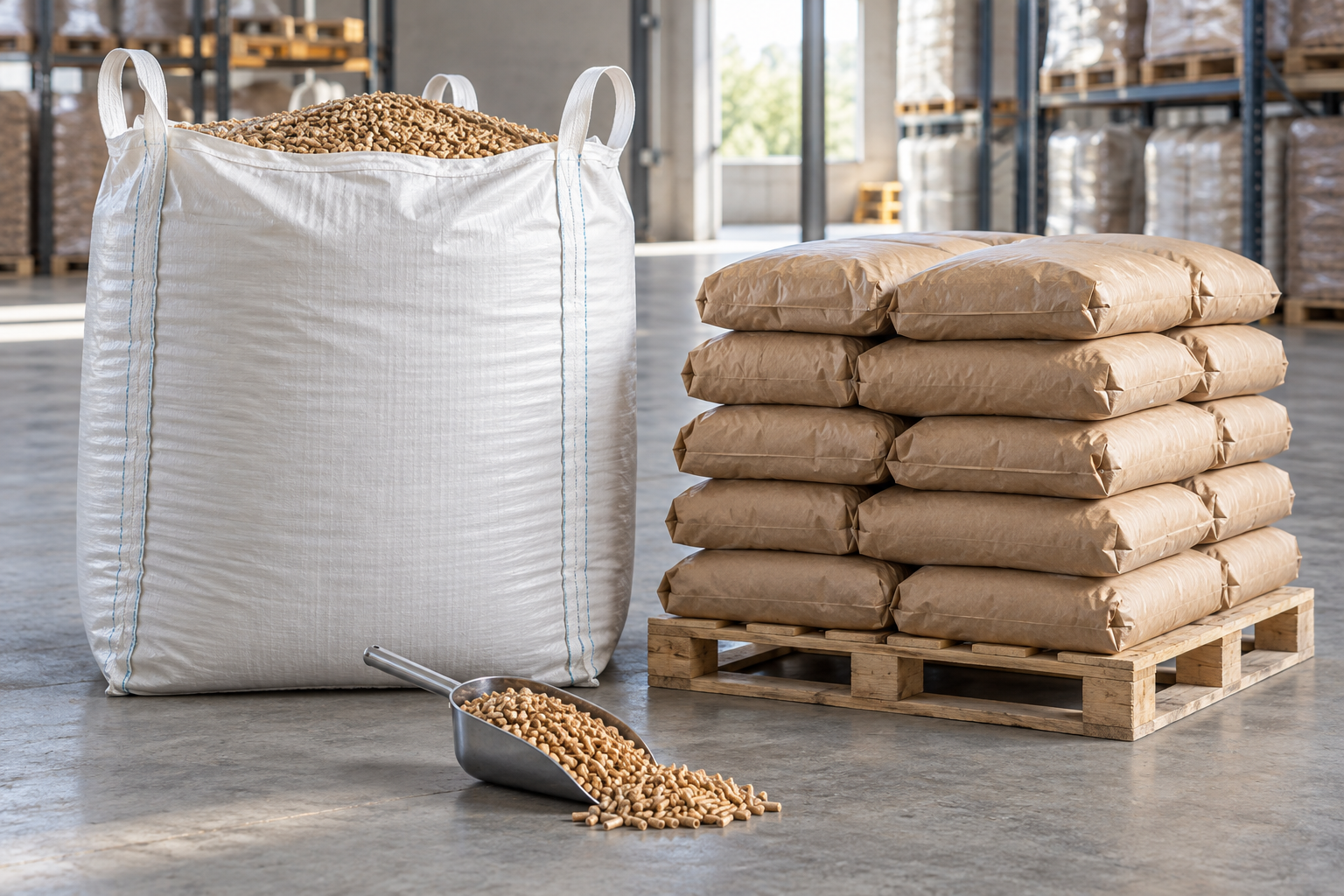
Made in Kazakhstan exclusively from Kazakhstan-sourced raw materials, Nord Panels wood pellets are available in Big Bags, standard 10–15 kg bags and a separate 5 kg retail format. For a European buyer, the right pack is not simply the lowest price per tonne: it is the format that fits the receiving equipment, storage layout, sales channel and label obligations.
Start with the handling unit, not the bag price
Map the route from the arriving vehicle to final use. Record whether the site has a forklift, safe lifting equipment for flexible intermediate bulk containers, pallet racking, manual-picking limits and weather-protected storage. Then define the commercial unit: net mass per bag, bags per pallet or Big Bag, pallet footprint and height, gross mass, stretch wrap and any liner. The quotation should state which figures are fixed and which require order-specific confirmation.
A packaging comparison is only meaningful at the same pellet specification and delivery basis. Ask for the current product data and a lot-specific certificate of analysis separately from the packaging schedule. See the Nord Panels wood pellet page for the live product presentation.
When a Big Bag is the better fit
Big Bags generally suit professional sites that consume larger quantities and can unload and dose them mechanically. They reduce the number of individual packs handled per tonne and can simplify internal transfers. The buyer should nevertheless approve the filled mass, bag dimensions, lifting-loop arrangement, discharge design, liner if used, palletisation and maximum stacking conditions.
Do not treat a flexible container as a lifting instruction. The receiving site must confirm compatible equipment, safe working procedures and the supplier’s handling information. Outdoor exposure is not a substitute for dry, protected storage; the order should define protection against rain, puncture and contamination during transport and unloading.
When 10–15 kg bags are the better fit
Small bags usually work better for manual distribution, dealer networks and locations without Big Bag handling equipment. They support unit-by-unit stock control and customer-facing presentation, but create more packaging units, more labels and more potential seal points per tonne.
Approve a pallet drawing before the first shipment. It should show bag count, net and gross pallet mass, footprint, overall height, layer pattern and restraint method. The artwork proof should also lock the product name, nominal mass, batch or traceability field, responsible operator details, barcode where required, handling and storage text, and the languages agreed for the destination market.
Keep the 5 kg retail format as a separate decision
Nord Panels also presents a 5 kg format for retail and pet-related applications. It should not be silently substituted for an industrial 10–15 kg programme. Retail packs can require different artwork, consumer information, merchandising, barcode structure and carton or pallet configuration. Quote and approve them as a separate stock-keeping unit.
Control claims, logos and artwork versions
No certification mark should be printed merely because a buyer requests it. Under the ENplus scheme, use of ENplus trademarks on bags is limited to authorised certified participants and approved bag designs. The second editions of ENplus ST 1001 and ST 1003 became effective on 1 January 2026 and clarify responsibilities around bags, Big Bags and trademark use. Check the current ENplus technical documentation and official standards update before artwork approval. This article does not state that Nord Panels or a quoted product is ENplus-certified.
Use a controlled artwork file with an owner, version number, approval date and destination markets. Any change in language, importer details, mass statement or claim should trigger a new approval. Keep the approved PDF with the purchase order and compare production samples against it.
Put EU packaging compliance into the purchase order
The EU Packaging and Packaging Waste Regulation, Regulation (EU) 2025/40, generally applies from 12 August 2026 and covers packaging placed on the EU market regardless of material or origin. It introduces lifecycle requirements, while several detailed obligations phase in later; harmonised consumer sorting labels are scheduled from 2028. Buyers should identify who is the producer or importer for the specific market, confirm registration and extended-producer-responsibility duties, and agree who supplies the required data and markings. Start with the European Commission’s PPWR overview and 11 August 2026 application notice. Local legal advice may still be needed.
For the RFQ, state destination country, annual and call-off volume, preferred format, nominal unit mass, pallet limits, unloading equipment, private-label needs, artwork languages, barcode system, delivery term and sample-trial requirement. Ask Nord Panels to confirm the available configuration for the specific quotation rather than assuming a generic European stock format.