






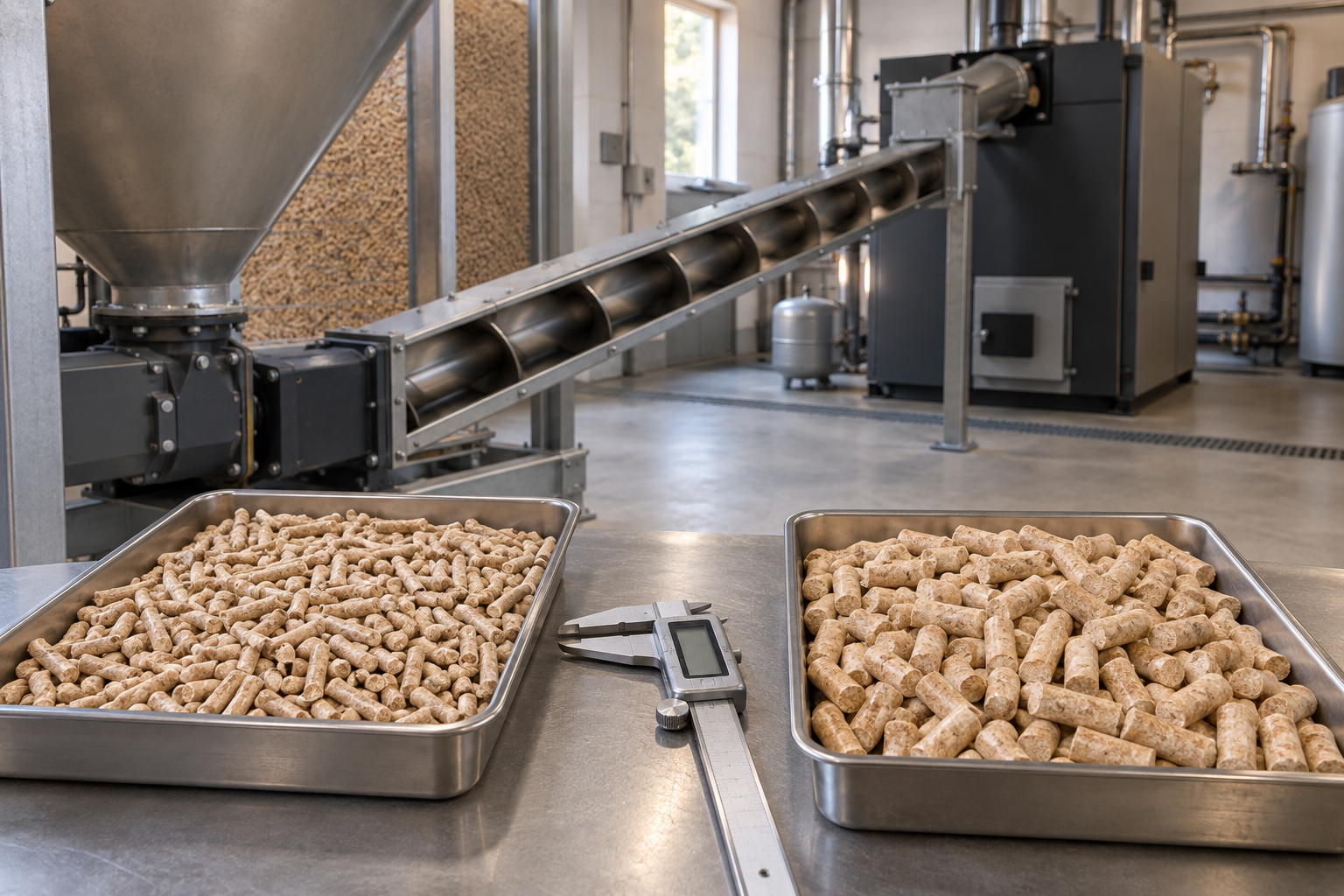
Choosing between 6 mm and 8 mm wood pellets is an equipment-compatibility decision, not a shortcut for ranking fuel quality. A European buyer should start with the installed boiler, burner, augers, pneumatic transfer route and dosing controls, then confirm the selected diameter through documents and a controlled trial before committing to volume.
1. Start with the equipment's approved fuel envelope
Ask the boiler or burner manufacturer for the current fuel specification for the exact model and control version. Record the accepted nominal diameter, length range, fines limit, bulk-density range and any restrictions for the feed screw, rotary valve, pneumatic line or day bin. A statement that a system “uses pellets” is not enough.
Map the entire route from vehicle or Big Bag discharge to the combustion chamber. The boiler may accept a diameter that a narrow transfer point, screen, dosing device or existing silo outlet does not. For a retrofit or a change of fuel supplier, obtain written confirmation from the equipment provider or responsible engineer rather than relying on an assumption from another site.
Keep market destination and equipment acceptance separate. EU, UK, Swiss and other European buyers may use similar technical references, but the installed system and purchase contract decide whether a particular delivery is suitable.
2. Treat diameter as a specified dimension, not a quality grade
ISO 17225-2:2021 defines fuel quality classes and specifications for graded wood pellets used in non-industrial and industrial applications. The current ENplus® ST 1001 second edition, published on 1 October 2025 and effective from 1 January 2026, lists both 6 ± 1 mm and 8 ± 1 mm as permitted diameter values in its A1, A2 and B table, with diameter measured according to ISO 17829.
That table is useful market context, but it does not mean that both diameters work in every appliance. It also does not make one diameter a higher quality class than the other. Certification status and diameter are different questions. Referencing ENplus® requirements in an RFQ must never be presented as proof that a supplier or product is ENplus® certified; certification should be verified separately through the official scheme.
Write the nominal diameter and the applicable measurement method into the specification. Do not accept a quotation that states only “standard pellets” when the receiving system needs a defined size.
3. Map every transfer and dosing point
Review the unloading connection, intake hopper, screens, magnets, elevators, augers, bends, rotary valves, weighing device, day bin and burner feed. For each point, record the manufacturer, model, clear opening, control logic, alarm history and maintenance condition. The question is not simply whether pellets pass through once, but whether the whole system feeds them consistently through normal starts, stops and load changes.
Pay particular attention to bottlenecks and to places where pellets are dropped, blown or repeatedly transferred. Handling can create fines, while accumulated fines can affect conveying and dosing. The ENplus® document itself notes that pellets can be damaged during handling and therefore calls for quality management across the supply chain.
Before changing diameter, clean the route and document the starting condition. Otherwise old material, a worn screw or a blocked screen can be mistaken for a fuel-size problem.
4. Run a controlled compatibility trial
Agree the trial plan before the vehicle or Big Bag is opened. Identify the delivery lot, retain a sealed reference sample and take comparison samples before and after the main conveying steps. Use the specified method for diameter and length; where fines are a decision parameter, define the sieve method and sampling point in advance.
During the trial, record:
- unloading time and any bridging or manual intervention;
- motor current, feed stability and alarm events at each transfer point;
- fines before and after conveying;
- dosing repeatability across low, medium and high boiler load;
- ignition, flame stability and shutdown behaviour under the equipment supplier's instructions;
- ash appearance and any maintenance observations after the agreed operating period.
Do not improvise machine settings or override safety devices to make a fuel pass the trial. If adjustment is required, it should be approved by the equipment supplier or responsible engineer and recorded as part of the accepted operating window.
5. Convert the trial into a purchase specification
The purchase order should state the nominal diameter, tolerance or referenced standard, agreed length limits, lot identification, sampling point, certificate-of-analysis fields and the acceptance rule for borderline results. Include mechanical durability and fines as separate parameters; a correct diameter alone does not guarantee that pellets will arrive intact after transport and handling.
Define what happens if the delivery does not match the approved trial: segregation, retest, controlled blending where technically authorised, or rejection. Keep the approved fuel sample, laboratory record, equipment confirmation and trial report under one revision number so that procurement, operations and the supplier are comparing the same basis.
For multi-site buyers, do not automatically extend one plant's approval to another. Silo geometry, conveying distance, burner design and control settings can differ even when the boiler nameplate looks similar.
6. Prepare a focused 8 mm enquiry to Nord Panels
The live Nord Panels wood pellet page presents 8 mm pellets. A useful enquiry should therefore include the receiving country's destination, annual and call-off volume, packaging format, unloading method, silo and conveying details, boiler or burner model, required test data and the planned compatibility-trial quantity.
Nord Panels manufactures in Kazakhstan using exclusively Kazakhstan-sourced raw materials. This origin statement does not replace technical acceptance: the buyer should still confirm that the offered 8 mm product fits the installed system and the written purchase specification. Send the completed equipment and delivery brief through the Nord Panels contact page so the commercial discussion begins with measurable requirements.