






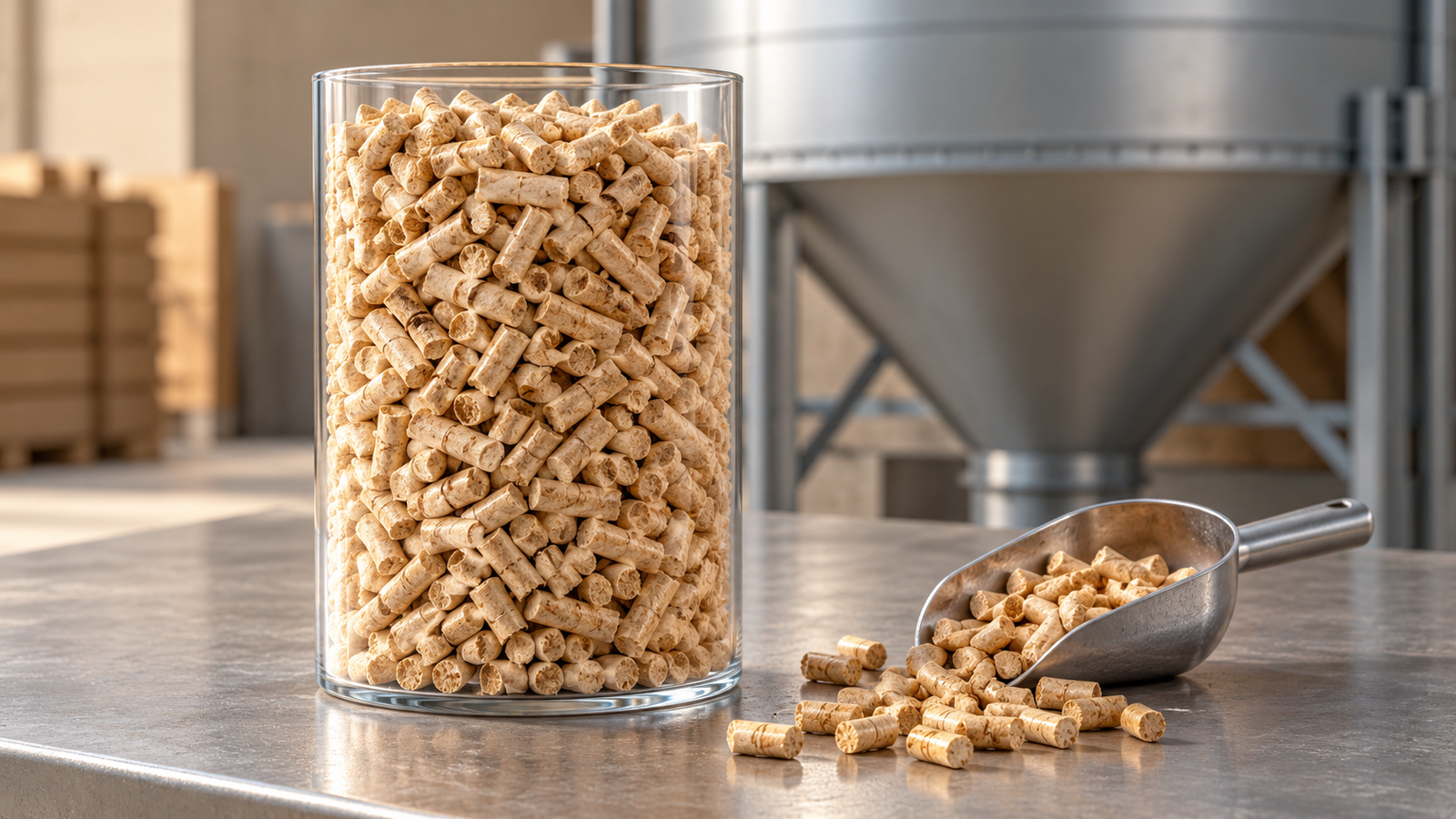
A delivery can meet its agreed mass and still exceed the space available at the receiving site. For European heating operators and pellet distributors, the purchasing question is practical: how many tonnes can the store accept when the vehicle arrives?
Nord Panels manufactures in Kazakhstan using exclusively Kazakhstan-sourced raw materials. This guide explains a planning calculation; the numerical examples are hypothetical and are not a declared density specification for Nord Panels pellets.
1. Use bulk density, not the density of one pellet
Bulk density relates pellet mass to the volume occupied by the poured material, including spaces between pellets. Particle density describes a different quantity. Substituting particle density in a storage calculation can seriously overstate the tonnage that fits.
Ask for a lot-relevant bulk-density result in kg/m³ and its test method. ISO 17828:2025 specifies standardized measurement; transport and storage conditions can produce different densities. [1] Record the report date and sample identity as well as the number. Agree which density range will be used for delivery planning.
2. Establish the free volume that can actually be filled
Start with the storage supplier's approved usable capacity. Gross room dimensions alone are insufficient: sloping floors, filling geometry and operating clearances affect the usable space. ENplus storage guidance also distinguishes usable volume from the full room volume. [2]
Keep three quantities separate
- Gross volume: the geometric enclosure volume.
- Usable capacity: the volume permitted for pellet storage under the approved design.
- Free usable volume: the portion available for the next delivery after remaining stock and agreed operational allowances are accounted for.
Have the receiving team confirm the final quantity without entering the store. The volume calculation does not establish structural capacity, safe filling conditions or permission to override level alarms. Retain the site's existing operating procedure.
3. Convert tonnes and cubic metres consistently
For a planning estimate:
Pellet volume (m³) = delivery mass (tonnes) × 1,000 ÷ bulk density (kg/m³).
Mass fitting the free volume (tonnes) = free usable volume (m³) × bulk density (kg/m³) ÷ 1,000.
Example: 20 m³ available for the delivery
Assume the site has confirmed 20 m³ of free usable volume after its operating allowances. The following densities are illustrative assumptions, not supplier limits.
| Assumed bulk density | Mass fitting 20 m³ | Volume needed for 13 tonnes |
|---|---|---|
| 600 kg/m³ | 12.0 t | 21.67 m³ |
| 650 kg/m³ | 13.0 t | 20.00 m³ |
| 700 kg/m³ | 14.0 t | 18.57 m³ |
A 13-tonne order fits the middle assumption exactly but exceeds the available volume at 600 kg/m³. If 600 kg/m³ is the agreed lower planning bound, 12 tonnes is the volume-based ceiling in this example, subject to every other site limit. Choose the lower credible density when checking how much space a fixed mass may require; do not assume a denser delivery to make the order fit.
4. Connect the calculation to the dispatch decision
Before dispatch, confirm the expected stock remaining on arrival, the method used to estimate it, the agreed density range and the receiving site's approved quantity. If stock is inferred from a level sensor, use the store's calibrated level-to-volume relationship rather than treating percentage height as percentage volume.
Keep delivery mass separate from this estimate: a density calculation is not a substitute for the agreed weighing record. For bagged deliveries, also check package dimensions, pallet footprints and stacking limits; loose-pellet volume does not determine warehouse space for packaged goods.
5. Put a capacity gate in the enquiry
A useful purchasing note is: “Please provide the available bulk-density evidence and planning range for the offered pellets. Dispatch quantity requires confirmation of free usable receiving capacity. Any change to quantity or delivery format must be agreed before loading.”
This workflow supports European B2B planning. Local requirements and the storage designer's instructions still govern the receiving installation; a UK guidance document is not an EU-wide site approval.
Nord Panels' wood pellets page presents Big Bag and bagged formats. Send the destination, required tonnage, receiving arrangement and capacity constraints through the contact page, and request the evidence available for the proposed supply. A reference to ENplus guidance here does not claim ENplus certification for Nord Panels.
Sources
- ISO 17828:2025 — determination of bulk density.
- ENplus GD UK 3001:2025 — storage guidance, sections 4.1.4 and 5.2.
- Forest Research — woodfuel storage and receiving arrangements.
Sources checked on 2 October 2026.