






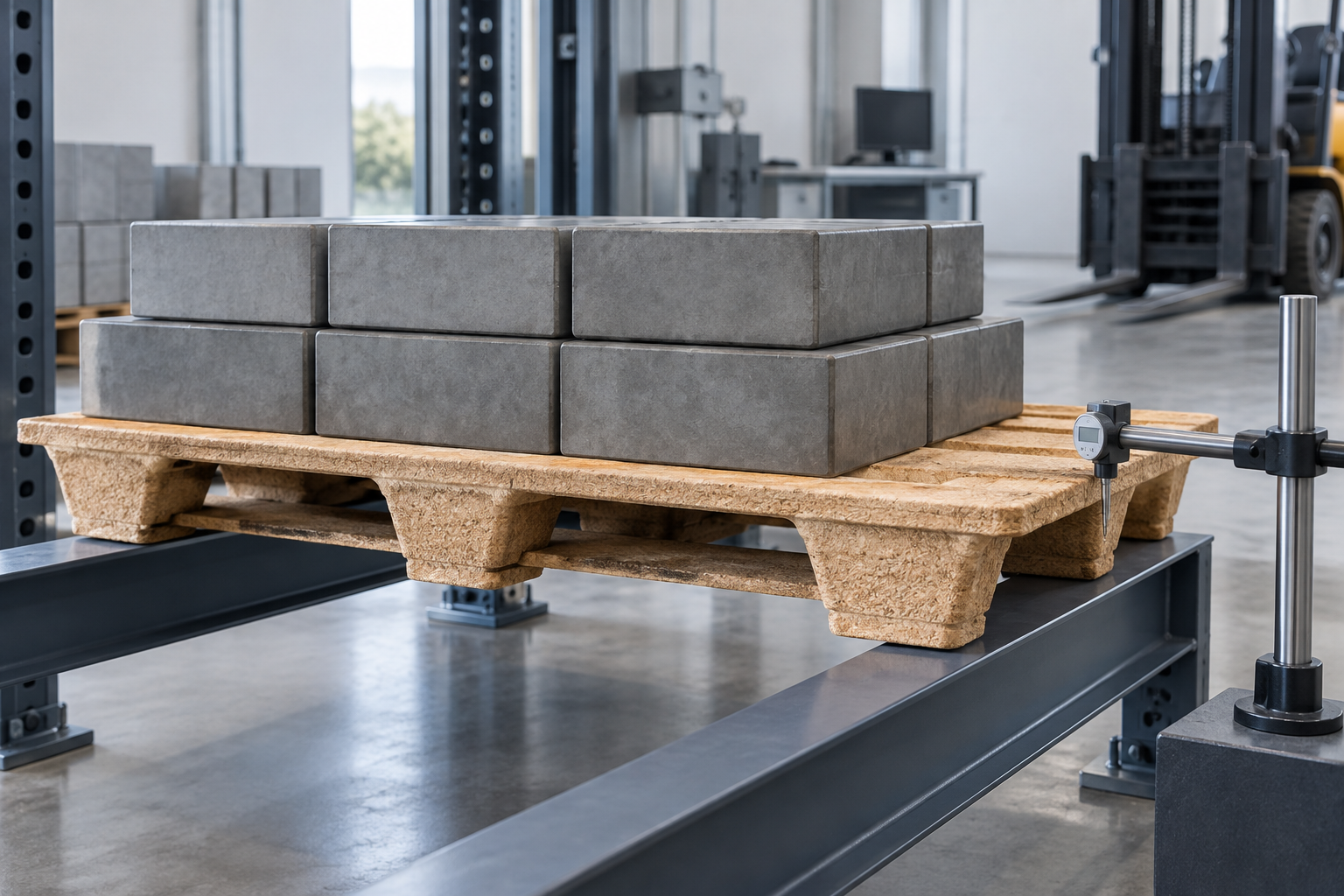
A pallet enquiry that asks only for “load capacity” is incomplete. A high value measured with the pallet fully supported on a floor cannot automatically be used for a pallet spanning rack beams, travelling on a conveyor or being lifted by forks. For European procurement, the useful question is not “What is the biggest number?” but “Which payload is permitted for this exact load and support condition?”
1. Start with the use case, not the headline value
Commercial specifications often list static, dynamic and racking loads. Treat these as separate declarations that require their own definitions and evidence. Do not select the largest figure and apply it to every stage of the route.
ISO 8611-2:2025 defines maximum working load around a specific loading and support condition. It also distinguishes the nominal load used in pallet comparison from the actual payload carried in use. This distinction is the foundation of a defensible purchase specification.
Map the full route before comparing offers: loading station, forklift or pallet truck, conveyor, truck or container, temporary floor storage, block stacking and any beam rack. A pallet may encounter several conditions in one shipment, so the lowest applicable approved value can govern the route.
2. Define every support condition
Write down how the pallet is supported at each decision point. Full-area floor support, fork support and a free span between rack beams are mechanically different. Conveyor tracks, chain conveyors and narrow support rails may create yet another arrangement.
Do not assume that a “dynamic” number automatically covers every forklift, pallet truck, speed, impact or wheel path. Ask the supplier to state the handling condition represented by that declaration. For racking, record the beam orientation, clear span, bearing width and whether a deck or safety support changes the setup.
ISO 8611-1:2025 provides test methods for new flat pallets, including groups for nominal load, maximum working load and durability comparison. A report should identify the relevant test and reproduce the support geometry closely enough for the buyer to compare it with the planned operation.
3. Describe the payload, not only its mass
Two loads with the same kilograms can act differently. Record the footprint of the goods, number and position of contact points, centre of gravity, overhang, load distribution and the method used to stabilise the unit load. A concentrated machine base is not equivalent to evenly distributed cartons.
ISO 8611-3:2011 addresses maximum working loads for new flat pallets with known payloads in different handling environments. The practical procurement conclusion is clear: a working-load decision should be connected to the known goods and support system, not copied from an unrelated test or catalogue line.
If the load changes by product family, create a controlled load diagram for each critical family. Show the pallet orientation and contact zones. Attach the approved diagram to the purchase order or technical specification.
4. Read the test report behind the number
Request a report for the exact pallet model, dimensions and material. Check the standard and edition, sample identification, date and laboratory, conditioning, number of specimens, support span, load applicators, test sequence, measured deflection, ultimate result and any deviation from the method.
A photograph of an impressive load is not a substitute for these details. Neither is a rating for another size or construction. Where the report states a nominal load, do not relabel it as the customer’s working payload without the required assessment.
The current ISO pages show that Parts 1 and 2 were updated in February 2025. Therefore, state the edition in new requests instead of writing only “ISO 8611”. This prevents the test basis from being left ambiguous.
5. Reconcile catalogue data before release
The live Nord Panels product page presents separate static, dynamic and rack values for its presswood pallet models and says test documentation is available on request. Use those public values to shortlist a model, then request the exact model specification and supporting report for the intended route.
If a summary card, table, quotation and report show different values, stop the release and resolve the discrepancy in writing. Record which document controls the order. Do not silently choose the highest number.
Keep the model reference and revision on the purchase order. If geometry, material, manufacturing process or drawing revision changes, require change notification and decide whether fresh qualification is necessary.
6. Verify the route with the receiving site
Send the pallet drawing, load diagram and proposed limits to the receiving warehouse. Ask it to confirm rack beam spacing, conveyor support, pallet-truck access, automated handling interfaces and any local restrictions. Acceptance by the carrier is not acceptance by the rack or automation owner.
For a new combination, use a controlled sample trial agreed with the site’s technical and safety teams. Observe entry, lifting, transfer, storage and retrieval under the intended load. A successful trial supports that defined combination; it does not create a universal rating.
7. Put the operating envelope into the order
A useful order clause identifies: pallet model and revision; dimensions; maximum permitted payload; payload diagram; support condition and span; handling equipment; environmental or conditioning limits; stacking or racking duration where relevant; inspection criteria; and change-control rules.
Nord Panels manufactures in Kazakhstan using exclusively Kazakhstan-sourced raw materials. Review the available models on the presswood pallet product page, then send the goods, load pattern, handling route and receiver requirements through the contact page. Ask for a model-specific proposal and the supporting documents needed for your decision.
Sources checked on 20 September 2026. The cover is an illustrative test-laboratory scene, not evidence of a certified load rating.