






Kazakhstan-only materials: Nord Panels manufactures in Kazakhstan and uses exclusively raw materials sourced in Kazakhstan. No imported raw material is used for the products described in this article.
Wood Pellets in Industrial Energy Supply
The global transition away from fossil fuels in industrial heating and power generation has accelerated adoption of solid biofuels, with wood pellets emerging as one of the most versatile and logistically manageable options available to energy operators. Wood pellets can fuel dedicated biomass boilers across a wide thermal capacity range, be co-fired with coal in existing boiler infrastructure with modest modification, or supply combined heat and power (CHP) plants to produce both electricity and useful heat simultaneously.
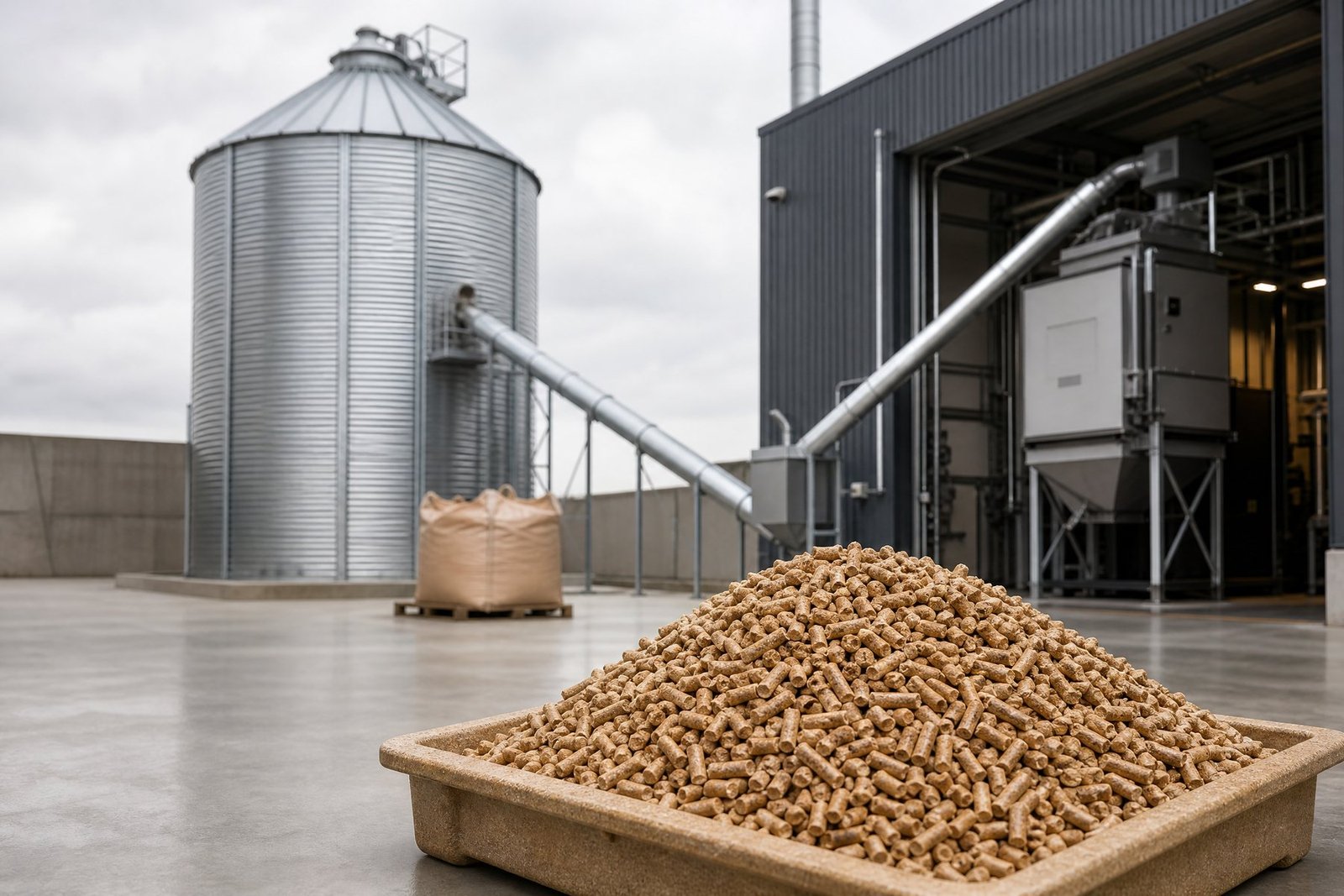
Nord Panels wood pellets are manufactured from birch fibre by-products generated by the company's plywood production facility in Petropavlovsk, Kazakhstan. The species-consistent birch feedstock — uniform in moisture content, ash chemistry, and lignin content — delivers pellets with predictable combustion behaviour that industrial energy operators value because it supports stable boiler control and reduces the frequency of unplanned maintenance events.
Industrial Grade Pellets and Applicable Standards
Industrial wood pellets are distinguished from premium residential grades primarily by the permissible range of ash content and, in some classification systems, accepted fines levels and sodium/potassium content that affect slagging behaviour. Relevant standards for industrial pellet supply include:
- ENplus B — the commercial and industrial tier of the European ENplus certification system
- ISO 17225-2 class I3 — the industrial pellet class within the ISO solid biofuel standards
- SBP (Sustainable Biomass Program) — the sustainability certification framework applied to utility-scale biomass procurement in European power markets
For industrial buyers in the power generation and district heating sector, the key quality parameters for Nord Panels birch wood pellets are:
- Net calorific value (as received): 4.6–4.9 kWh/kg — the high lignin content of birch contributes to this competitive energy density
- Moisture content: ≤ 10 % — low moisture maximises net energy yield per tonne and minimises freight cost per unit of energy delivered
- Ash content: 0.4–0.7 % — birch produces very low ash compared with agricultural residue pellets (often 3–8 %) and straw-blend fuels; this markedly reduces clinker and slag formation in industrial grates and underfeed burners
- Sulphur content: < 0.05 % — negligible sulphur eliminates SO₂ emission compliance concerns that affect coal-fired installations
- Chlorine content: < 0.02 % — low chlorine prevents corrosion of heat exchangers, superheaters, and economisers
- Mechanical durability (DU): ≥ 96.5 % per ISO 17831-1 — industrial handling systems involving pneumatic conveying, bucket elevators, and auger feeds impose mechanical stress; adequate pellet durability minimises fines generation in the handling chain
Applications in Industrial Heating and Power
Industrial thermal and power applications for wood pellets span a wide capacity and technology range:
District heating plants (1–50 MW thermal): Municipal and commercial district heating systems have widely adopted wood pellets as primary or backup fuel. Continuous seasonal operation makes low ash content particularly valuable, as it extends the interval between grate cleaning and de-ashing, reducing planned maintenance shutdowns during the heating season. Birch pellets' predictable combustion behaviour supports stable flame management in automated boiler control systems.
Industrial process heating: Food processing facilities, agricultural drying operations (grain, animal feed, timber), textile mills, brick kilns, and building materials plants all have thermal process requirements that can be met cost-effectively with pellet-fired systems. For Kazakh and Central Asian industrial buyers, domestically produced pellets from Nord Panels reduce dependence on imported fossil fuels and provide a degree of fuel cost stability that oil and gas contracts do not always offer.
Combined heat and power (CHP): Small and medium-scale CHP installations in the 0.5–5 MW electrical range using organic Rankine cycle (ORC) turbines or steam turbine generators can utilise wood pellets as primary fuel to co-produce electricity and heat. The predictable combustion characteristics and uniform heat release rate of birch pellets support stable ORC or steam cycle operation, maximising electrical efficiency and minimising turbine control interventions.
Co-firing in coal boilers: Existing coal-fired industrial boilers can meaningfully reduce their carbon footprint by substituting a proportion of coal energy with wood pellets in co-firing configurations. Typical substitution ratios of 5–20 % of thermal input are achievable without significant boiler modification and deliver proportional reductions in fossil CO₂ emissions and particulate formation. Birch pellets' very low ash content reduces the risk of deposit formation and grate fouling that can occur when co-firing higher-ash biofuels such as agricultural residue pellets or wood-bark blends.
Packaging and Supply Formats for Industrial Operations
Nord Panels wood pellets for industrial and commercial applications are supplied in formats matched to the scale and infrastructure of the buyer:
15 kg polyethylene bags: The standard format for space heating boilers up to approximately 100 kW — schools, offices, farms, and small commercial premises. Bags are palletised in EUR 800 × 1200 mm pallet loads of 65–70 bags (975–1,050 kg gross), stretch-wrapped for moisture protection. Palletised bags can be handled with standard fork trucks and stored in covered warehousing or under tarpaulin where building storage is limited.
500 kg and 1,000 kg big bags (FIBC): The preferred format for medium-scale industrial boilers in the 100 kW to 2 MW range, pellet blending operations, and distribution depots that repack into consumer bags. Big bags fitted with discharge spouts can be suspended above boiler fill hoppers for direct gravity-feed discharge, eliminating manual shovelling. The big bag format is also described in detail in the companion article on birch wood pellets bulk supply from Nord Panels.
Loose bulk by pneumatic tanker: For operations with dedicated pellet silos of several hundred cubic metres capacity, bulk delivery by pneumatic tanker eliminates all packaging cost and manual bag handling. Tankers fill silos through external inlet connections, and a single delivery can fill a large silo to capacity, minimising the management overhead associated with frequent fuel deliveries. Rail-based bulk movements in covered wagons are available for large consumers at greater distances from the Petropavlovsk plant.
Environmental and Regulatory Considerations
Regulatory drivers for industrial pellet adoption include the EU Renewable Energy Directive (RED II), Kazakhstan's national policy targets for renewable energy capacity, and corporate commitments to carbon reduction aligned with Paris Agreement trajectories. Wood pellets produced from by-product wood fibre — as is the case at Nord Panels — receive favourable treatment under most sustainability certification frameworks because they do not compete with primary timber markets for raw material and derive from a material that would otherwise be waste.
For energy generators subject to emissions trading schemes or mandatory carbon reporting, the biogenic origin of CO₂ emitted from pellet combustion means that emissions are typically classified outside the fossil fuel reporting scope under most national and international protocols. The extremely low sulphur content eliminates SO₂ monitoring obligations that coal users must satisfy, and the negligible chlorine content removes corrosion risk from heat exchanger surfaces.
Buyers with sustainability due diligence requirements can request batch-specific quality test certificates and raw material traceability documentation from Nord Panels. The production plant's quality management system maintains records throughout the production chain, from raw material receipt to outbound shipment, supporting third-party audits and buyer sustainability reporting at any level of detail required.
Quality Assurance and Batch Documentation
Industrial energy buyers require fuel quality documentation that goes beyond a single specification sheet. Nord Panels maintains a structured quality assurance programme for its wood pellet production, including incoming raw material moisture monitoring, in-process particle size and moisture checks, and finished product sampling per batch.
Each production batch is sampled at the pellet press output for the following parameters: diameter, length distribution, moisture content (oven dry per ISO 18134), ash content (per ISO 18122), mechanical durability (per ISO 17831-1), and net calorific value (per ISO 18125 or calculated from proximate and ultimate analysis). Results are recorded in the batch quality management system and are available as a certificate of analysis with each commercial consignment.
For buyers requiring third-party verified quality assurance, arrangements can be made for independent laboratory sampling and analysis at the point of production or at the delivery destination. This service is particularly relevant for large-volume contracts where fuel quality directly affects boiler performance guarantees or regulatory compliance reports. The plant also supports buyer audits for sustainability certification purposes, providing access to raw material provenance records and production process documentation.
Partnering with Nord Panels for Industrial Pellet Supply
Long-term supply agreements can be structured with fixed or index-linked pricing, defined delivery schedules, and quality guarantee provisions tailored to the operational requirements of industrial energy buyers who need fuel supply certainty for budget planning and asset management purposes.
To discuss industrial pellet supply requirements, request quality test documentation, or explore long-term volume agreements, visit the wood pellets catalog or contact the Nord Panels commercial team through the contact page. Nord Panels also produces birch plywood and ISPM-15-compliant presswood pallets at the same facility, offering a consolidated sourcing option for wood-based industrial products. Company background, production statistics, and quality certifications are available at about Nord Panels.