






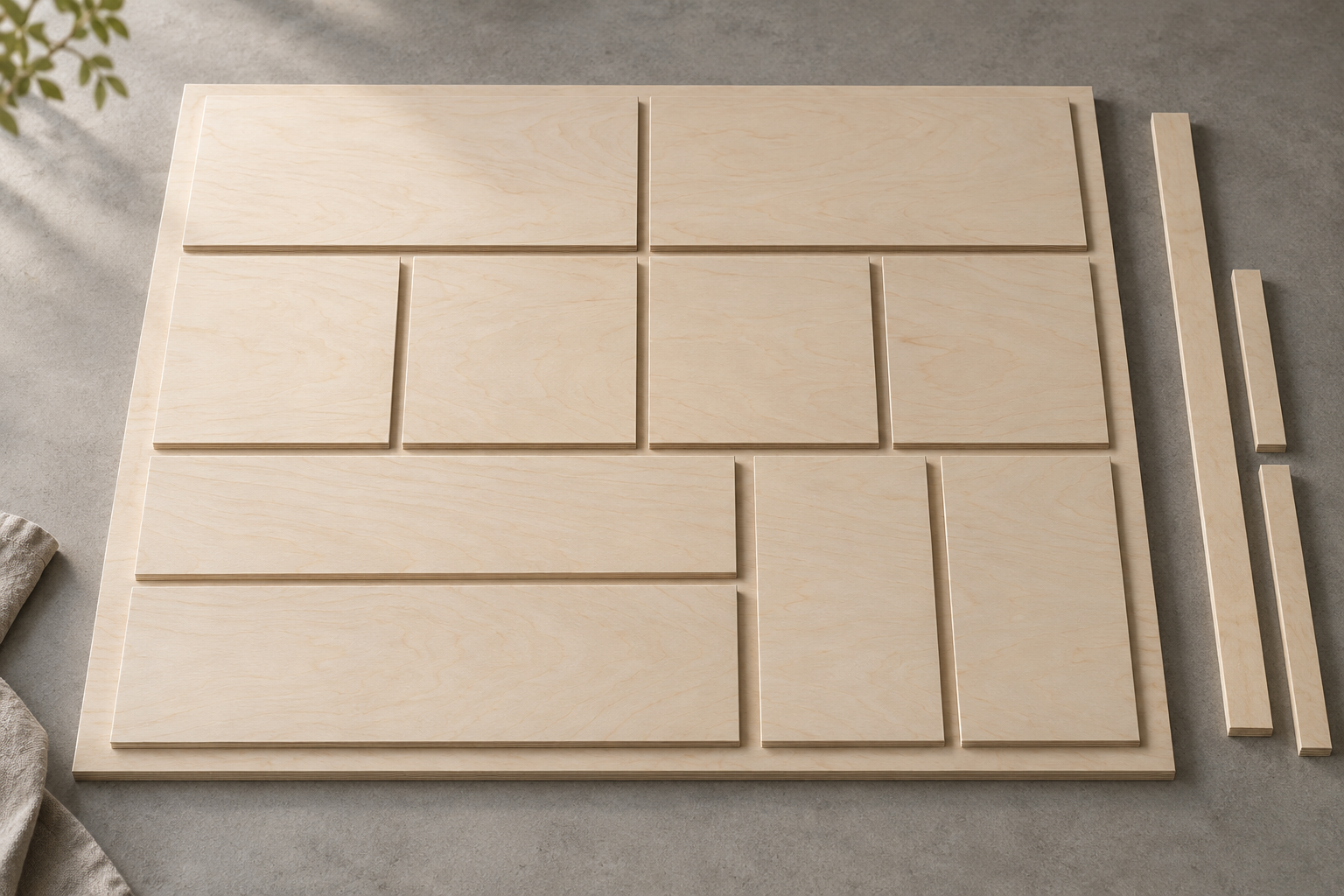
For European furniture and shopfitting buyers, the cheapest plywood sheet is not necessarily the cheapest source of finished components. A format that fits one extra row of parts can change the purchasing decision more than a small difference in price per square metre.
Nord Panels produces birch plywood in Kazakhstan using only Kazakhstan-sourced raw materials. Its live plywood catalogue lists 1220×2440 and 1250×2500 mm formats. Confirm availability for the required thickness, face grade and product line in the quotation.
1. Compare usable layouts, not nominal area alone
A 2500×1250 mm sheet has 3.125 m² of nominal area; 2440×1220 mm has 2.9768 m². The difference is approximately 4.98%. That does not mean every cutting list produces 4.98% more usable parts.
Start with the actual part list and define:
- Blank dimensions at the cutting stage, including any later machining allowance.
- Quantity and material specification for each part.
- Permitted rotation and required face-grain direction.
- Edge-trimming allowance, saw kerf and machine limitations.
- Appearance restrictions, matching requirements and excluded surface areas.
Keep these inputs identical when comparing formats. Do not improve a layout by silently relaxing the customer's appearance or orientation requirements.
2. A worked example: a small width difference changes the count
This is an illustrative rectangular grid calculation, not a guaranteed factory yield or an optimized CNC programme. Assume identical 600×400 mm blanks, with the 600 mm side fixed along the sheet's long direction. Rotation is not allowed. Reserve 10 mm at each outer edge and 4 mm between adjacent blanks. Assume no defects or additional machining allowance.
| Calculation | 2440×1220 mm | 2500×1250 mm |
|---|---|---|
| Usable rectangle after edge allowance | 2420×1200 mm | 2480×1230 mm |
| Blanks along the long direction | 4 | 4 |
| Rows across the width | 2 | 3 |
| Blanks in this layout | 8 | 12 |
Four blanks need 4×600 + 3×4 = 2412 mm along the length. Three rows need 3×400 + 2×4 = 1208 mm across the width. The latter fits within 1230 mm but not within 1200 mm. The remaining margins in the stated layouts also leave room to separate the residual strip.
The larger sheet gives 50% more blanks in this particular example, not in every order. Different part sizes, allowed rotation, defect exclusions or tool spacing can reverse or remove the advantage.
3. Convert the layout into a comparable cost
For an initial material-only comparison:
Material cost per usable blank = sheet cost allocated to the job ÷ usable blanks produced.
With purely hypothetical sheet prices of €60 and €66, the two layouts give €60/8 = €7.50 and €66/12 = €5.50 per blank. These are not Nord Panels prices and exclude processing, delivery and other charges.
For the purchase decision, compare both offers on the same delivery and tax basis. Then add cutting time, handling, tool cost, subsequent processing and expected rejects. Credit reusable offcuts only when there is a realistic identified use; do not count the same credit twice.
HOMAG's cutting-optimization documentation distinguishes alternatives such as minimum waste, material cost and handling. These are useful separate comparison criteria, not a claim that Nord Panels uses this software.
4. Validate the assumptions on the actual process
HOMAG's trim documentation also treats the four edge allowances separately. The 10 mm value above is an example, not a universal recommendation.
Ask the fabricator to run the same bill of materials on both formats using the actual machine and tool settings. For CNC nesting, use the required toolpath spacing and holding constraints rather than copying the saw example. Check the first batch against the planned blank count, appearance acceptance and cycle time.
Confirm that the larger format can be stored, moved and processed on the buyer's equipment. Do not change a part's required orientation simply to improve yield; any structural design requirements remain a separate approval.
5. Put the comparison into the plywood enquiry
In your enquiry to Nord Panels, specify both candidate formats, thickness, face/back grade, surface type, order volume and delivery destination. Attach the part list and orientation restrictions if relevant. Ask for separate format quotations and confirm whether any cutting service is actually included.
This is a procurement comparison for European buyers, not a claim of local European stock or a promise that one format is always cheaper.
Cover: AI-generated material arrangement, not a production cutting plan. Source pages checked on 9 September 2026.