






A screw joint should be approved as a combination of panel, fastener and assembly process—not from the phrase “good screw holding”. For European furniture, shopfitting and industrial-component buyers, the useful purchasing question is: will the proposed joint work consistently in our actual product?
Nord Panels manufactures birch plywood in Kazakhstan using exclusively Kazakhstan-sourced raw materials. The plywood catalogue identifies the available product lines. This guide proposes a qualification workflow; it does not declare a screw capacity for Nord Panels plywood or provide structural design values.
1. Separate the failure modes before requesting a test
Thread withdrawal
Here the screw pulls out of the material holding its thread. Record which member receives the thread and whether insertion is into a panel face or edge. Do not transfer a face-insertion result to an edge joint without relevant evidence. EN 13446 addresses fastener withdrawal in wood-based panels; agree the applicable procedure with the laboratory. DIN EN 13446.
Head pull-through
Here the screw head passes through the retained panel. This is a different question from thread withdrawal. EN 1383 covers head pull-through, including wood-based products, but excludes fully threaded screws. Confirm method suitability before commissioning tests. BSI EN 1383.
Also ask the test team to record splitting, joint opening, permanent movement and fastener damage where relevant. A single maximum-force number can hide an unacceptable failure mode.
2. Freeze the panel and fastener specification
Prepare a joint drawing and a short bill of materials before comparing quotations. Record:
- Panel product, thickness, surface, grade and batch identity.
- Screw manufacturer and exact reference, diameter, total length, threaded length, head shape and coating.
- Thread engagement in the receiving member, insertion direction, edge distances and screw spacing.
- Pilot-hole and clearance-hole details, countersinking, washers or brackets, where used.
- Assembly equipment, tightening control and intended disassembly or reuse.
Use the fastener manufacturer's instructions and the responsible designer's specification for dimensions and installation limits. There is no universal pilot-hole diameter or tightening torque for all birch plywood joints. A change of screw supplier is a controlled specification change, even when the nominal dimensions look identical.
3. Make the trial representative of production
Agree sampling, conditioning, loading direction, test method and acceptance criteria before testing. Use traceable panels and the actual production fasteners. Include the surface treatment and machining process that will be used in the finished component.
Keep separate records for face and edge insertion. If a product will be repeatedly assembled, test that intended sequence rather than assuming a first installation represents later installations. Agree with the laboratory how service conditions and repeated loading will be represented. Do not improvise a load test on installed furniture or an occupied structure.
Ask for individual results and observed failure modes, not only an average or the strongest specimen. The responsible engineer or product specialist must decide what the results mean for the intended use; a laboratory maximum is not automatically an allowable working load.
4. Approve the assembled product as well
A satisfactory screw test does not by itself approve a cabinet, shelf unit or shopfitting assembly. For storage furniture, ISO 7170 addresses testing of assembled units for strength, durability and stability; its test methods do not set acceptance criteria. ISO 7170:2021.
Before release, identify the destination market, intended user, product requirements and applicable test programme. Do not treat one furniture test report as blanket approval for every European market or for a structural construction application. Structural joints require project-specific design and evidence outside this purchasing checklist.
5. Put the release conditions in the purchase order
Define who approves the trial, which drawing revision is released and which changes require another review. Retain the panel batch, screw reference, installation settings, test report and approved sample together. This makes a later production issue traceable to a particular combination rather than to “plywood” in general.
For a Nord Panels enquiry, send the application, drawing, panel thickness and finish, order volume, destination and proposed fastener arrangement. Request confirmation of panel availability and discuss representative samples before a production order. Joint qualification remains a separate agreement; the catalogue alone is not a screw-load guarantee.
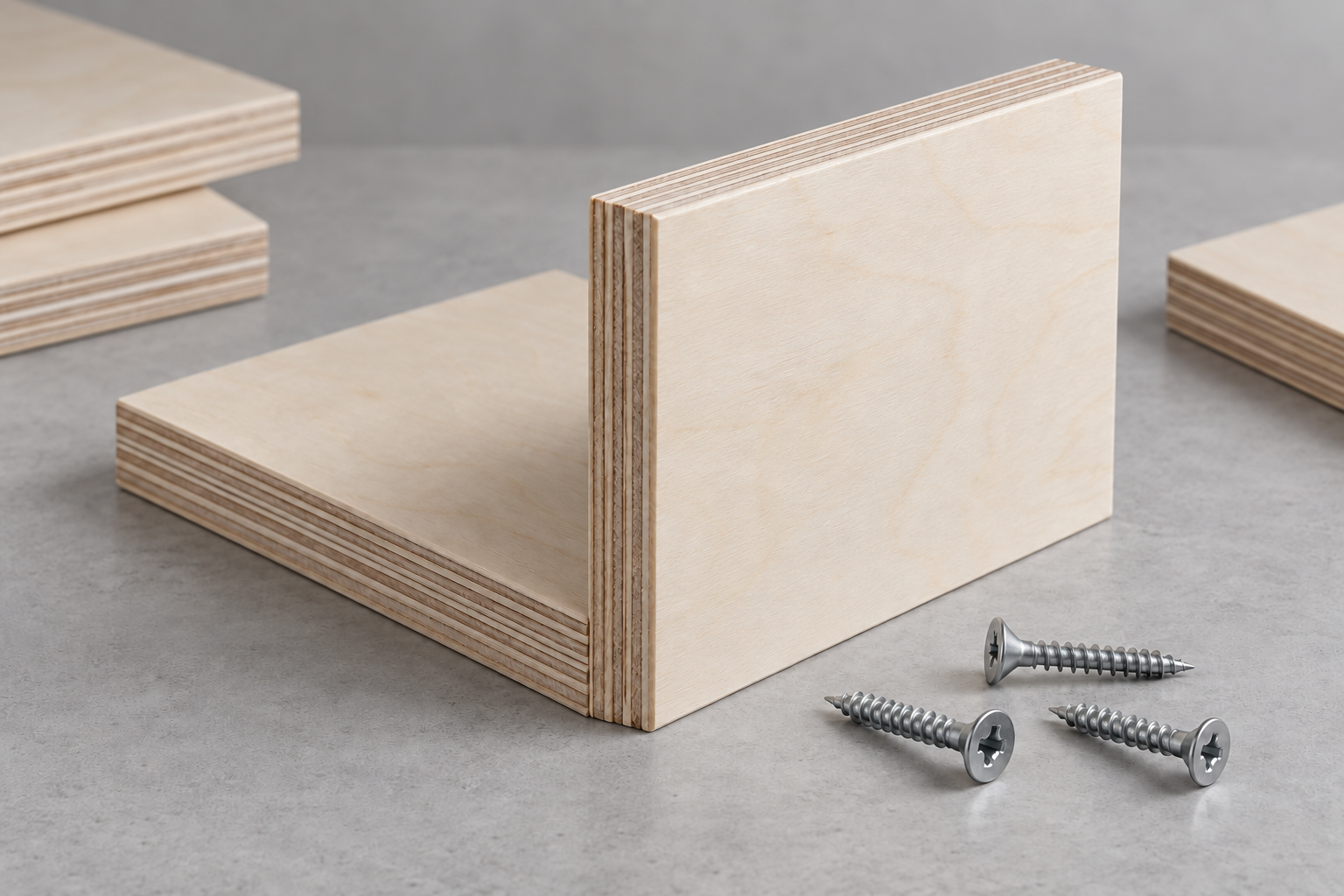
Cover: AI-generated illustration of plywood samples and screws, not a test setup or a photograph of the factory. Source pages checked on 7 September 2026.