






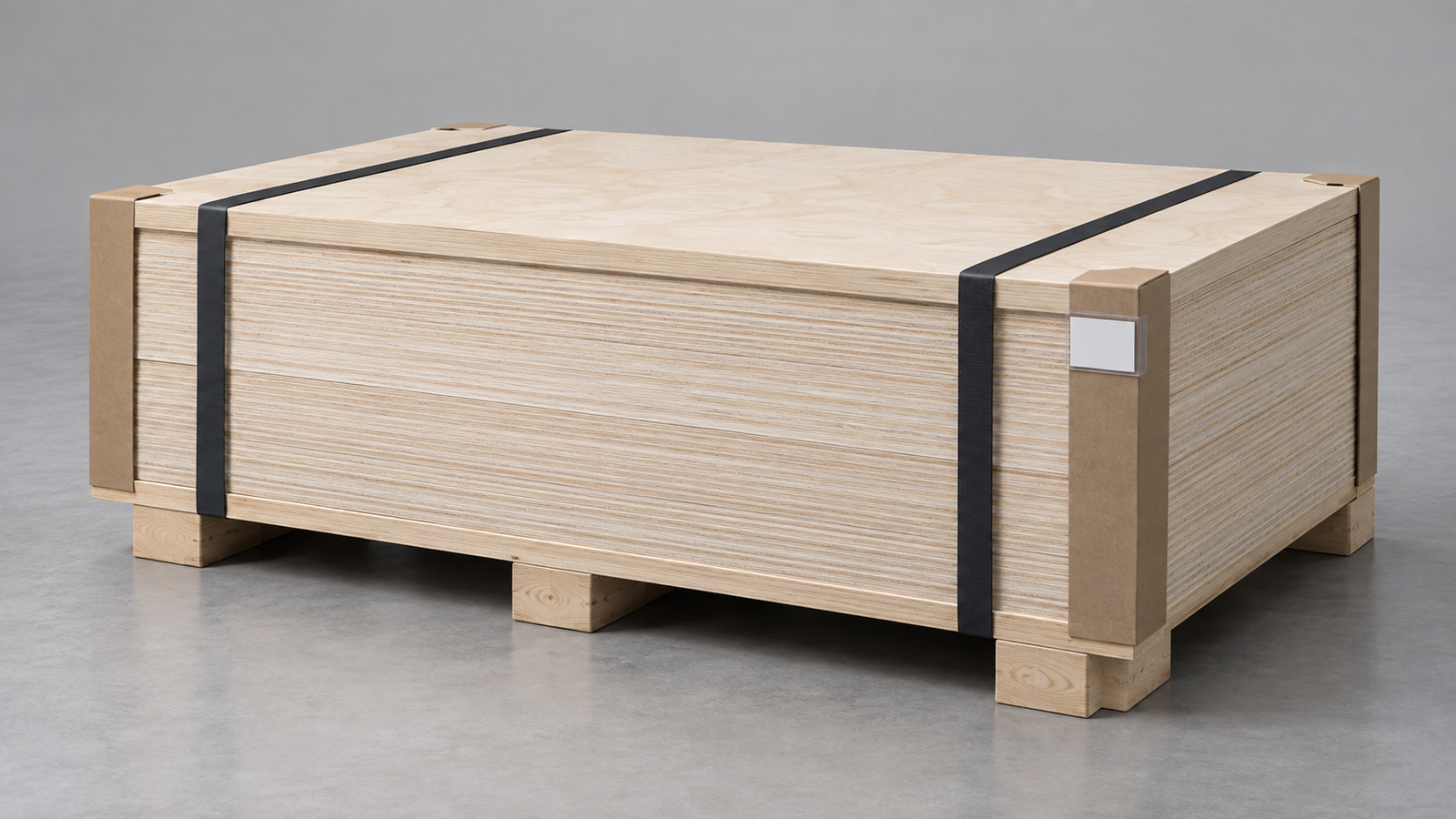
Packaging should be agreed before a birch plywood order is released, not negotiated after damaged panels arrive. A useful specification connects the sales order, each physical pack and the carrier's load-securing plan. It also gives the receiving team evidence they can compare with the delivered condition.
Nord Panels manufactures birch plywood in Kazakhstan using exclusively Kazakhstan-sourced raw materials. Its live plywood catalogue lists panel formats and product options. Buyers should confirm the selected format, thickness, grade, quantity and packaging arrangement in the quotation.
1. Separate the panel pack from the vehicle restraint system
A plywood pack must hold the panels together, protect vulnerable surfaces and remain suitable for the agreed handling method. The vehicle or container must then restrain that pack against movement during transport. These are related but different functions. Stretch film, a weather cover or a neat-looking band does not by itself prove that the load is safely secured to the vehicle.
For UK road transport, the DVSA consignor guidance says the load should be in a suitable transport condition, packaged so it can be secured and stable before loading. It also recommends communicating with the operator. This is UK guidance; responsibilities and enforcement must be checked for the actual route and destination. In the EU, Annex III of Directive 2014/47/EU provides principles used in roadside inspection of cargo securing.
2. Put a pack schedule into the purchase order
Create one line for each pack type. Do not rely on a generic phrase such as “export packing”. Record:
- Order line, panel format, nominal thickness, face/back grade and surface type.
- Planned sheet count per pack and the method for identifying partial packs.
- Estimated gross pack mass and the agreed tolerance or verification method.
- Top, bottom, face, edge and corner protection required.
- Number, material and approximate position of pack straps or bands.
- Bearer arrangement, permitted fork-entry directions and handling restrictions.
- Weather or moisture protection, including where ventilation is required.
- Pack number, production lot reference, quantity and destination markings.
The correct pack size and bearer spacing depend on sheet dimensions, pack mass, equipment and route. Do not copy a universal number from another order. Ask the supplier and carrier to confirm that the proposed handling unit works with the forklift, trailer or container that will actually be used.
3. Prevent the protection system from damaging the plywood
Straps can mark faces or crush edges when force is concentrated. Specify corner or edge guards beneath bands and define whether a protective top sheet is required. Bands should retain the pack without bowing the stack or cutting into the panel edges. Bearers should create safe fork access while supporting the pack consistently; their locations must also suit the unloading equipment.
Weather protection needs its own acceptance language. Define which faces are covered, how seams are closed and what constitutes a repairable tear. A cover can protect against rain or dirt, but it is not automatically a vapour barrier and is not a substitute for vehicle restraint. If the route or storage plan creates a condensation risk, agree the protection and inspection method with the logistics parties instead of promising a moisture outcome from wrapping alone.
4. Make labels useful at receiving
A receiving team should be able to connect a physical pack to the order without opening every bundle. Agree a durable label location and minimum data: supplier, buyer order number, pack number, product description, dimensions, declared quantity, lot reference and gross or net mass when applicable. Avoid placing the only label where it will be hidden against another pack.
Use handling symbols only when their meaning is clear to all parties. ISO 780:2015 covers graphical symbols for handling and storage of packages. Referencing the standard is more reliable than inventing similar-looking icons, but it does not replace written handling instructions or route-specific legal requirements.
5. Define the pre-shipment evidence set
Request a short, repeatable photo record linked to the pack numbers:
- Overall pack from two sides before loading.
- Close views of protected corners, edges, straps and bearers.
- Readable pack label and quantity reference.
- Pack position after loading and the vehicle restraint arrangement.
- Any repaired cover, changed strap or accepted deviation.
The DVSA's suggested load-plan information includes load weight, position, securing method, unloading instructions and a dated photograph. The DVSA securing-method guidance also notes that straps can be damaged by sharp or abrasive edges and recommends sleeves or protectors. These points help buyers write evidence requirements; they do not prescribe one securing calculation for every shipment.
Photos are evidence of a moment, not a warranty of final condition. State who approves deviations, when the carrier takes responsibility and which documents travel with the shipment.
6. Add the checklist to the enquiry
In your enquiry to Nord Panels, provide the destination, transport mode, unloading equipment and any buyer-specific label template. Ask for the proposed sheets per pack, estimated pack mass, protection components and photo set as separate confirmation points. Confirm whether packaging, loading and vehicle restraint are included in the quoted scope rather than assuming they are the same service.
This pre-shipment specification complements a receiving inspection; it does not replace one. It also does not claim European local stock or a standard package suitable for every buyer.
Cover: AI-generated illustration, not an actual Nord Panels shipment. Source pages checked on 10 September 2026.Packaging should be agreed before a birch plywood order is released, not negotiated after damaged panels arrive. A useful specification connects the sales order, each physical pack and the carrier's load-securing plan. It also gives the receiving team evidence they can compare with the delivered condition.
Nord Panels manufactures birch plywood in Kazakhstan using exclusively Kazakhstan-sourced raw materials. Its live plywood catalogue lists panel formats and product options. Buyers should confirm the selected format, thickness, grade, quantity and packaging arrangement in the quotation.
1. Separate the panel pack from the vehicle restraint system
A plywood pack must hold the panels together, protect vulnerable surfaces and remain suitable for the agreed handling method. The vehicle or container must then restrain that pack against movement during transport. These are related but different functions. Stretch film, a weather cover or a neat-looking band does not by itself prove that the load is safely secured to the vehicle.
For UK road transport, the DVSA consignor guidance says the load should be in a suitable transport condition, packaged so it can be secured and stable before loading. It also recommends communicating with the operator. This is UK guidance; responsibilities and enforcement must be checked for the actual route and destination. In the EU, Annex III of Directive 2014/47/EU provides principles used in roadside inspection of cargo securing.
2. Put a pack schedule into the purchase order
Create one line for each pack type. Do not rely on a generic phrase such as “export packing”. Record:
- Order line, panel format, nominal thickness, face/back grade and surface type.
- Planned sheet count per pack and the method for identifying partial packs.
- Estimated gross pack mass and the agreed tolerance or verification method.
- Top, bottom, face, edge and corner protection required.
- Number, material and approximate position of pack straps or bands.
- Bearer arrangement, permitted fork-entry directions and handling restrictions.
- Weather or moisture protection, including where ventilation is required.
- Pack number, production lot reference, quantity and destination markings.
The correct pack size and bearer spacing depend on sheet dimensions, pack mass, equipment and route. Do not copy a universal number from another order. Ask the supplier and carrier to confirm that the proposed handling unit works with the forklift, trailer or container that will actually be used.
3. Prevent the protection system from damaging the plywood
Straps can mark faces or crush edges when force is concentrated. Specify corner or edge guards beneath bands and define whether a protective top sheet is required. Bands should retain the pack without bowing the stack or cutting into the panel edges. Bearers should create safe fork access while supporting the pack consistently; their locations must also suit the unloading equipment.
Weather protection needs its own acceptance language. Define which faces are covered, how seams are closed and what constitutes a repairable tear. A cover can protect against rain or dirt, but it is not automatically a vapour barrier and is not a substitute for vehicle restraint. If the route or storage plan creates a condensation risk, agree the protection and inspection method with the logistics parties instead of promising a moisture outcome from wrapping alone.
4. Make labels useful at receiving
A receiving team should be able to connect a physical pack to the order without opening every bundle. Agree a durable label location and minimum data: supplier, buyer order number, pack number, product description, dimensions, declared quantity, lot reference and gross or net mass when applicable. Avoid placing the only label where it will be hidden against another pack.
Use handling symbols only when their meaning is clear to all parties. ISO 780:2015 covers graphical symbols for handling and storage of packages. Referencing the standard is more reliable than inventing similar-looking icons, but it does not replace written handling instructions or route-specific legal requirements.
5. Define the pre-shipment evidence set
Request a short, repeatable photo record linked to the pack numbers:
- Overall pack from two sides before loading.
- Close views of protected corners, edges, straps and bearers.
- Readable pack label and quantity reference.
- Pack position after loading and the vehicle restraint arrangement.
- Any repaired cover, changed strap or accepted deviation.
The DVSA's suggested load-plan information includes load weight, position, securing method, unloading instructions and a dated photograph. The DVSA securing-method guidance also notes that straps can be damaged by sharp or abrasive edges and recommends sleeves or protectors. These points help buyers write evidence requirements; they do not prescribe one securing calculation for every shipment.
Photos are evidence of a moment, not a warranty of final condition. State who approves deviations, when the carrier takes responsibility and which documents travel with the shipment.
6. Add the checklist to the enquiry
In your enquiry to Nord Panels, provide the destination, transport mode, unloading equipment and any buyer-specific label template. Ask for the proposed sheets per pack, estimated pack mass, protection components and photo set as separate confirmation points. Confirm whether packaging, loading and vehicle restraint are included in the quoted scope rather than assuming they are the same service.
This pre-shipment specification complements a receiving inspection; it does not replace one. It also does not claim European local stock or a standard package suitable for every buyer.
Cover: AI-generated illustration, not an actual Nord Panels shipment. Source pages checked on 10 September 2026.Packaging should be agreed before a birch plywood order is released, not negotiated after damaged panels arrive. A useful specification connects the sales order, each physical pack and the carrier's load-securing plan. It also gives the receiving team evidence they can compare with the delivered condition.
Nord Panels manufactures birch plywood in Kazakhstan using exclusively Kazakhstan-sourced raw materials. Its live plywood catalogue lists panel formats and product options. Buyers should confirm the selected format, thickness, grade, quantity and packaging arrangement in the quotation.
1. Separate the panel pack from the vehicle restraint system
A plywood pack must hold the panels together, protect vulnerable surfaces and remain suitable for the agreed handling method. The vehicle or container must then restrain that pack against movement during transport. These are related but different functions. Stretch film, a weather cover or a neat-looking band does not by itself prove that the load is safely secured to the vehicle.
For UK road transport, the DVSA consignor guidance says the load should be in a suitable transport condition, packaged so it can be secured and stable before loading. It also recommends communicating with the operator. This is UK guidance; responsibilities and enforcement must be checked for the actual route and destination. In the EU, Annex III of Directive 2014/47/EU provides principles used in roadside inspection of cargo securing.
2. Put a pack schedule into the purchase order
Create one line for each pack type. Do not rely on a generic phrase such as “export packing”. Record:
- Order line, panel format, nominal thickness, face/back grade and surface type.
- Planned sheet count per pack and the method for identifying partial packs.
- Estimated gross pack mass and the agreed tolerance or verification method.
- Top, bottom, face, edge and corner protection required.
- Number, material and approximate position of pack straps or bands.
- Bearer arrangement, permitted fork-entry directions and handling restrictions.
- Weather or moisture protection, including where ventilation is required.
- Pack number, production lot reference, quantity and destination markings.
The correct pack size and bearer spacing depend on sheet dimensions, pack mass, equipment and route. Do not copy a universal number from another order. Ask the supplier and carrier to confirm that the proposed handling unit works with the forklift, trailer or container that will actually be used.
3. Prevent the protection system from damaging the plywood
Straps can mark faces or crush edges when force is concentrated. Specify corner or edge guards beneath bands and define whether a protective top sheet is required. Bands should retain the pack without bowing the stack or cutting into the panel edges. Bearers should create safe fork access while supporting the pack consistently; their locations must also suit the unloading equipment.
Weather protection needs its own acceptance language. Define which faces are covered, how seams are closed and what constitutes a repairable tear. A cover can protect against rain or dirt, but it is not automatically a vapour barrier and is not a substitute for vehicle restraint. If the route or storage plan creates a condensation risk, agree the protection and inspection method with the logistics parties instead of promising a moisture outcome from wrapping alone.
4. Make labels useful at receiving
A receiving team should be able to connect a physical pack to the order without opening every bundle. Agree a durable label location and minimum data: supplier, buyer order number, pack number, product description, dimensions, declared quantity, lot reference and gross or net mass when applicable. Avoid placing the only label where it will be hidden against another pack.
Use handling symbols only when their meaning is clear to all parties. ISO 780:2015 covers graphical symbols for handling and storage of packages. Referencing the standard is more reliable than inventing similar-looking icons, but it does not replace written handling instructions or route-specific legal requirements.
5. Define the pre-shipment evidence set
Request a short, repeatable photo record linked to the pack numbers:
- Overall pack from two sides before loading.
- Close views of protected corners, edges, straps and bearers.
- Readable pack label and quantity reference.
- Pack position after loading and the vehicle restraint arrangement.
- Any repaired cover, changed strap or accepted deviation.
The DVSA's suggested load-plan information includes load weight, position, securing method, unloading instructions and a dated photograph. The DVSA securing-method guidance also notes that straps can be damaged by sharp or abrasive edges and recommends sleeves or protectors. These points help buyers write evidence requirements; they do not prescribe one securing calculation for every shipment.
Photos are evidence of a moment, not a warranty of final condition. State who approves deviations, when the carrier takes responsibility and which documents travel with the shipment.
6. Add the checklist to the enquiry
In your enquiry to Nord Panels, provide the destination, transport mode, unloading equipment and any buyer-specific label template. Ask for the proposed sheets per pack, estimated pack mass, protection components and photo set as separate confirmation points. Confirm whether packaging, loading and vehicle restraint are included in the quoted scope rather than assuming they are the same service.
This pre-shipment specification complements a receiving inspection; it does not replace one. It also does not claim European local stock or a standard package suitable for every buyer.
Cover: AI-generated illustration, not an actual Nord Panels shipment. Source pages checked on 10 September 2026.Packaging should be agreed before a birch plywood order is released, not negotiated after damaged panels arrive. A useful specification connects the sales order, each physical pack and the carrier's load-securing plan. It also gives the receiving team evidence they can compare with the delivered condition.
Nord Panels manufactures birch plywood in Kazakhstan using exclusively Kazakhstan-sourced raw materials. Its live plywood catalogue lists panel formats and product options. Buyers should confirm the selected format, thickness, grade, quantity and packaging arrangement in the quotation.
1. Separate the panel pack from the vehicle restraint system
A plywood pack must hold the panels together, protect vulnerable surfaces and remain suitable for the agreed handling method. The vehicle or container must then restrain that pack against movement during transport. These are related but different functions. Stretch film, a weather cover or a neat-looking band does not by itself prove that the load is safely secured to the vehicle.
For UK road transport, the DVSA consignor guidance says the load should be in a suitable transport condition, packaged so it can be secured and stable before loading. It also recommends communicating with the operator. This is UK guidance; responsibilities and enforcement must be checked for the actual route and destination. In the EU, Annex III of Directive 2014/47/EU provides principles used in roadside inspection of cargo securing.
2. Put a pack schedule into the purchase order
Create one line for each pack type. Do not rely on a generic phrase such as “export packing”. Record:
- Order line, panel format, nominal thickness, face/back grade and surface type.
- Planned sheet count per pack and the method for identifying partial packs.
- Estimated gross pack mass and the agreed tolerance or verification method.
- Top, bottom, face, edge and corner protection required.
- Number, material and approximate position of pack straps or bands.
- Bearer arrangement, permitted fork-entry directions and handling restrictions.
- Weather or moisture protection, including where ventilation is required.
- Pack number, production lot reference, quantity and destination markings.
The correct pack size and bearer spacing depend on sheet dimensions, pack mass, equipment and route. Do not copy a universal number from another order. Ask the supplier and carrier to confirm that the proposed handling unit works with the forklift, trailer or container that will actually be used.
3. Prevent the protection system from damaging the plywood
Straps can mark faces or crush edges when force is concentrated. Specify corner or edge guards beneath bands and define whether a protective top sheet is required. Bands should retain the pack without bowing the stack or cutting into the panel edges. Bearers should create safe fork access while supporting the pack consistently; their locations must also suit the unloading equipment.
Weather protection needs its own acceptance language. Define which faces are covered, how seams are closed and what constitutes a repairable tear. A cover can protect against rain or dirt, but it is not automatically a vapour barrier and is not a substitute for vehicle restraint. If the route or storage plan creates a condensation risk, agree the protection and inspection method with the logistics parties instead of promising a moisture outcome from wrapping alone.
4. Make labels useful at receiving
A receiving team should be able to connect a physical pack to the order without opening every bundle. Agree a durable label location and minimum data: supplier, buyer order number, pack number, product description, dimensions, declared quantity, lot reference and gross or net mass when applicable. Avoid placing the only label where it will be hidden against another pack.
Use handling symbols only when their meaning is clear to all parties. ISO 780:2015 covers graphical symbols for handling and storage of packages. Referencing the standard is more reliable than inventing similar-looking icons, but it does not replace written handling instructions or route-specific legal requirements.
5. Define the pre-shipment evidence set
Request a short, repeatable photo record linked to the pack numbers:
- Overall pack from two sides before loading.
- Close views of protected corners, edges, straps and bearers.
- Readable pack label and quantity reference.
- Pack position after loading and the vehicle restraint arrangement.
- Any repaired cover, changed strap or accepted deviation.
The DVSA's suggested load-plan information includes load weight, position, securing method, unloading instructions and a dated photograph. The DVSA securing-method guidance also notes that straps can be damaged by sharp or abrasive edges and recommends sleeves or protectors. These points help buyers write evidence requirements; they do not prescribe one securing calculation for every shipment.
Photos are evidence of a moment, not a warranty of final condition. State who approves deviations, when the carrier takes responsibility and which documents travel with the shipment.
6. Add the checklist to the enquiry
In your enquiry to Nord Panels, provide the destination, transport mode, unloading equipment and any buyer-specific label template. Ask for the proposed sheets per pack, estimated pack mass, protection components and photo set as separate confirmation points. Confirm whether packaging, loading and vehicle restraint are included in the quoted scope rather than assuming they are the same service.
This pre-shipment specification complements a receiving inspection; it does not replace one. It also does not claim European local stock or a standard package suitable for every buyer.
Cover: AI-generated illustration, not an actual Nord Panels shipment. Source pages checked on 10 September 2026.