






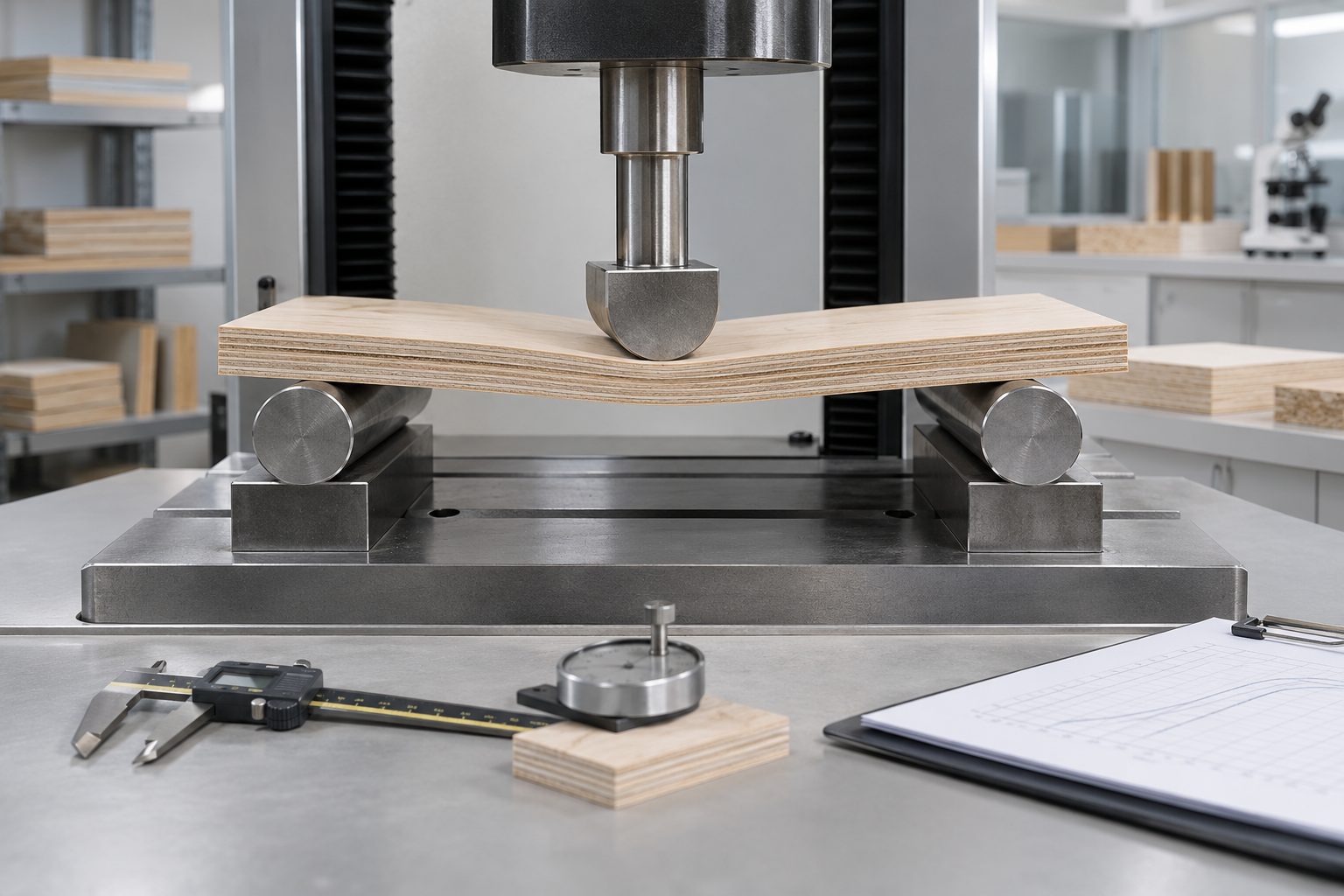
A bending-strength number without its test conditions is not a complete purchasing specification. The same birch plywood panel can produce different results when the specimen direction, thickness, conditioning, support span or calculation method changes. Buyers should therefore compare like with like and connect laboratory evidence to the actual part and load case.
1. Separate strength from stiffness
Bending strength describes the stress calculated at failure in a defined test. Modulus of elasticity in bending describes the panel's apparent stiffness within the measured elastic range. A panel can be comparatively stiff without having the same failure behaviour as another panel, so the two values are not interchangeable.
Write both properties separately when both matter. Shelves, vehicle floors, furniture frames and industrial components may be limited by deflection before they approach failure. The purchasing question is therefore not only how much load a panel can resist, but also how much it may bend under the permitted service load.
2. State the panel direction
Plywood is directional. The orientation of the face grain and the lay-up affect the result, so a single unlabelled value can hide the weaker direction. A report and a purchase specification should state whether the test specimen is parallel or perpendicular to the face grain, using the terminology of the selected method.
Do not assume that rotating a sheet or a cut component by 90 degrees leaves performance unchanged. Mark the principal direction on drawings and nesting plans where bending governs the part. If both directions can occur in service, request and assess results for both.
3. Name the method and edition
ISO 16978:2003 specifies a method for determining apparent modulus of elasticity and bending strength of wood-based panels in flatwise bending. ISO states that the publication was reviewed and confirmed in 2025, so it remains current as of the source check date below.
A test-method reference is essential because it fixes how the specimen, supports, loading and calculation are handled. Record the full standard number and edition in the enquiry, report and purchase order. If another method is proposed, require the supplier and laboratory to identify it and explain whether the results are directly comparable.
4. Fix thickness, span and conditioning
Request the tested nominal and measured thickness, specimen dimensions, support span, loading direction and conditioning history. These details belong beside the result, not in an unavailable laboratory note. Results from a different thickness or construction should not be copied into the acceptance criteria for the ordered panel without a documented technical basis.
Moisture and temperature conditioning can influence panel behaviour and measurement repeatability. Define the conditioning used for qualification and the state in which incoming samples will be tested. This is separate from deciding whether the product is suitable for the eventual service environment.
5. Link the result to a lot and construction
A useful report identifies the manufacturer, product line, thickness, lay-up or construction reference, surface configuration, sample date, lot or batch, laboratory, specimen count and individual as well as summary results. A catalogue value without this identity may help screening, but it is weak evidence for releasing a specific delivery.
Check whether the tested product matches the ordered F/F, F/W or uncoated EXT configuration. Film, mesh, sanding and thickness can change the finished panel and the way the sample is prepared. Require notification before a material, lay-up, adhesive system or process change that could affect the approved evidence.
6. Convert the design need into acceptance evidence
Start with the component: support points, clear span, load footprint, load duration, permitted deflection, cut-outs, drilled holes, edge distance and safety factors chosen by the responsible designer. A laboratory coupon result is not by itself a safe working load for a finished shelf, floor or machine part.
For a new application, qualify a controlled sample in the intended geometry and record the approved drawing, panel direction and machining. Agree how production lots will be sampled and what happens when one result is outside the agreed limit. Keep engineering approval separate from routine receiving inspection.
7. Put a comparison table in the purchase file
Use one row per offer or report and columns for product reference, thickness, face-grain direction, test method and edition, conditioning, support span, specimen count, bending strength, bending modulus, lot identity and document date. Leave a cell blank rather than treating an unstated condition as equivalent.
Nord Panels manufactures in Kazakhstan using exclusively Kazakhstan-sourced raw materials. Review the available F/F, F/W and EXT configurations on the birch plywood product page, then send the component drawing, load case, thickness, direction and required evidence through the contact page. Ask for documentation tied to the proposed product and batch before approval.
Sources checked on 21 September 2026. The cover is an illustrative laboratory scene, not evidence of a declared product value.