






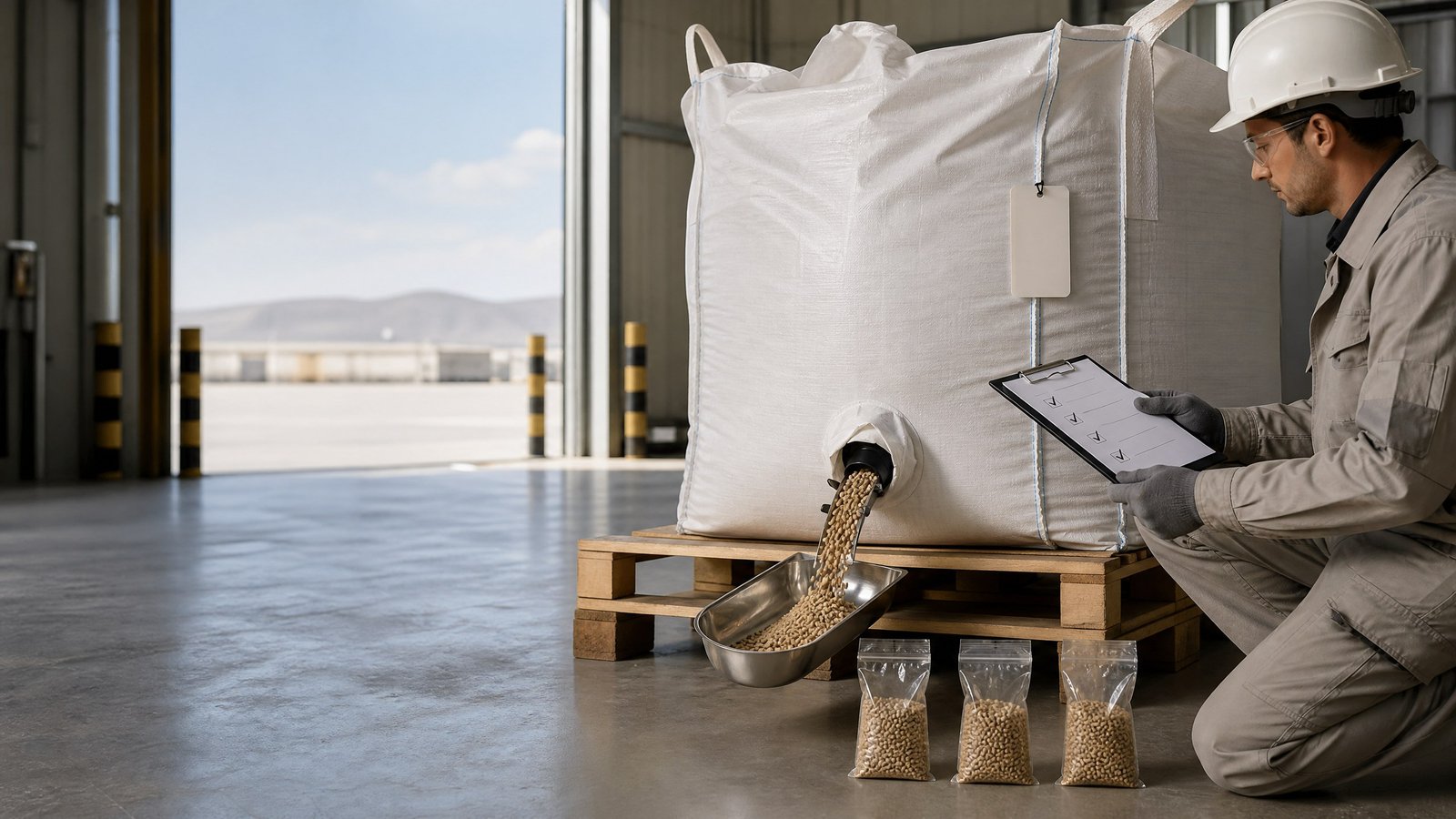
Industrial Wood Pellet Delivery Acceptance: Sampling, COA Checks and Lot Release
A wood pellet purchase is not complete when the vehicle reaches the gate. For an industrial boiler operator, distributor or quality team, the decisive moment is lot release: confirming that the delivered material matches the contract before it enters a silo, blending system or production process.
A specification sheet describes the product that was ordered. A certificate or certificate of analysis can document a particular batch. Neither replaces a disciplined receiving check. The receiving team still needs to connect the physical load to its documents, inspect the condition of the delivery, obtain a representative sample and record an accept, hold or reject decision.
This guide provides a practical workflow for bulk and Big Bag deliveries. It is designed for procurement, quality assurance, warehouse and energy-plant teams in the EU, EEA, United Kingdom, Switzerland and other European markets. Contract wording, plant permits and boiler requirements always take priority over a generic checklist.
1. Define acceptance before the purchase order is released
The strongest acceptance process starts in the contract, not at the weighbridge. The buyer and seller should agree what constitutes a lot, which properties are controlled, which test methods apply and what happens if the result is disputed.
| Contract item | What the buyer should define |
|---|---|
| Lot identity | One vehicle, one container, one production batch or another unambiguous unit |
| Product and class | The agreed wood pellet grade or buyer-specific industrial specification |
| Result basis | As-received, dry basis or another stated basis for each parameter |
| Test method | The applicable ISO/EN method and its current edition |
| Acceptance limits | Maximum, minimum and any agreed tolerance for each controlled property |
| Sampling point | Loading, arrival, discharge stream or another defined point |
| Testing party | Supplier laboratory, buyer laboratory or independent accredited laboratory |
| Dispute sample | Sealed retained sample, custody rules and retest procedure |
| Decision rule | Release, conditional release, quarantine, rework, price adjustment or rejection |
ISO 17225-2 defines quality classes and specifications for graded wood pellets used in industrial and non-industrial applications. It covers pellets made from specified wood categories, including by-products and residues from wood processing.[1] The purchase contract should identify the class or buyer specification actually ordered rather than relying on the word “pellets” alone.
2. Start with a documentary gate
Before unloading, compare the purchase order, delivery note, vehicle or container identification, packaging marks and any batch certificate. A technically plausible report is not useful if it cannot be tied to the load at the gate.
A practical documentary check should confirm:
| Document field | Acceptance question |
|---|---|
| Supplier and product | Do the names match the purchase order? |
| Batch or lot code | Is the same code shown on the delivery note, bags and COA? |
| Quantity and packaging | Do the declared tonnes and packaging format match the delivery? |
| Production and test dates | Are they consistent with the batch and shipment timeline? |
| Test methods | Are the methods identified, rather than only the results? |
| Reporting basis | Are moisture, calorific value and other results reported on the agreed basis? |
| Laboratory | Is the laboratory identified, and is the relevant accreditation scope available when required? |
A certification mark and a lot-specific COA answer different questions. A standard defines requirements; certification provides independent evidence that a product, process or service conforms to defined requirements. ENplus makes this distinction explicitly.[2] Buyers should therefore avoid treating a logo, a generic technical data sheet and a batch-linked test report as interchangeable documents.
3. Inspect the delivery before it is mixed with stock
The receiving team should record the physical condition of the load before discharge. Photographs, seal numbers, vehicle condition and packaging observations are inexpensive evidence if a disagreement develops later.
For Big Bags, check that the bag identification agrees with the delivery documents; seams, liners and lifting loops are intact; and there is no visible water ingress, foreign material or excessive breakage. For bulk deliveries, check the cleanliness and dryness of the transport compartment, the integrity of seals where used and the condition of pellets at the first accessible point.
Do not release a questionable load directly into a common silo. Once material from different deliveries is mixed, isolating the disputed lot and establishing causation becomes much harder.
4. Build a representative sampling plan
ISO 18135 covers sampling plans, sampling certificates and manual or mechanical sampling of solid biofuels. Its scope explicitly includes wood pellets and delivery situations such as lorry loads.[3] The central principle is representativeness: a sample taken from one convenient surface point may not reflect fines, moisture or segregation across the whole lot.
A defensible sampling plan should state the lot, the number and distribution of increments, the equipment, the sampling point, the sampler, the time and the intended tests. For a moving stream, increments can be collected at controlled intervals during discharge. For Big Bags, the selected bags and sampling positions should represent the lot rather than only the easiest bags to reach.
The increments are combined into a composite sample. The composite sample must then be reduced without changing its composition. BS EN ISO 14780 addresses preparation of laboratory samples and test portions, while BS EN ISO 18135 addresses the original sampling operation.[4] Mixing these stages informally can introduce bias even when the laboratory method itself is correct.
5. Split, seal and label the sample
A useful chain-of-custody arrangement divides the prepared material into three sealed portions: one for testing, one retained by the buyer and one available as a counter-sample for the supplier or an independent retest. The contract should define the required sample mass and retention period because these depend on the tests and dispute process.
As an example of a formal quality scheme, ENplus requirements for certified traders in Germany call for a retained sample of at least 1.5 kg for each vehicle loading. The sample is taken during loading, preferably from falling material, sealed, labelled with the sampling location, date, quality class and vehicle or delivery-note reference, and stored under suitable conditions for at least nine months.[5] This is an ENplus scheme example, not a universal legal rule and not a claim that Nord Panels holds ENplus certification.
At minimum, each buyer sample should carry the supplier, product, lot code, delivery reference, date and time, sampling point, sampler’s name, seal number and intended analyses. The same information should appear in the receiving record.
6. Match every result to a method and a commercial decision
ISO and corresponding European or British adoptions provide separate methods for the principal solid-biofuel properties. UK Forest Research lists BS EN ISO methods for sampling, sample preparation, moisture, ash, calorific value, bulk density and mechanical durability.[4]
| Buyer question | Typical controlled property | Method family to specify |
|---|---|---|
| How much usable fuel is in the delivered mass? | Moisture content | ISO 18134 series |
| How much mineral residue will remain? | Ash content | ISO 18122 |
| Will handling create excessive breakage? | Mechanical durability | ISO 17831-1 |
| Will the handling and storage system receive the expected mass per volume? | Bulk density | ISO 17828 |
| What energy value is being purchased? | Calorific value | ISO 18125 |
| Are dimensions compatible with the feed system? | Pellet diameter and length | Applicable ISO pellet-dimension method |
| Is excess dust present at delivery? | Fines content | Applicable ISO fines method and agreed sampling point |
The method matters because a number without a stated procedure or result basis may not be comparable with the contract. The laboratory’s scope matters as well. UKAS states that ISO/IEC 17025 accreditation evaluates technical competence, test-method validity, equipment, environment, sample handling and data quality assurance.[6] DAkkS similarly describes ISO/IEC 17025 as the worldwide standard for competence, impartiality and consistent laboratory practice.[7]
For cross-border contracts, the parties should name the accepted laboratory or require accreditation for the specific method in advance. National accreditation directories—including UKAS in the United Kingdom, DAkkS in Germany and Cofrac in France—allow buyers to verify accredited bodies and their scopes.[6] [7] [8]
7. Use a three-way release decision
A binary accept/reject rule can force poor decisions when documents are incomplete but the product has not yet been shown to be non-conforming. A three-way system is more practical:
| Decision | When to use it | Operational action |
|---|---|---|
| Release | Identity, condition, documents and agreed results meet the contract | Authorise transfer to the receiving silo or process |
| Hold | Identity is uncertain, documents are incomplete or results require confirmation | Keep the lot segregated; do not consume or blend it |
| Reject or resolve contractually | Contamination, material non-conformity or confirmed failure against the agreed limit | Follow the contract’s rejection, rework, replacement or commercial-adjustment procedure |
If a result is disputed, test the sealed retained sample under the contractually agreed method and laboratory route. Record who opened the sample, the seal condition, the date and the instruction sent to the laboratory. This evidence is more reliable than attempting to reconstruct the history after the load has been consumed.
8. A concise receiving checklist
Before accepting an industrial pellet delivery, the receiving team should be able to answer yes to the following questions:
| Gate | Question |
|---|---|
| Identity | Can the physical load be tied to one purchase order, delivery note and lot code? |
| Condition | Is the vehicle or packaging clean, dry, intact and free of visible contamination? |
| Documents | Is a batch-linked COA or agreed quality document present and internally consistent? |
| Sampling | Was the sample taken from representative increments under a written plan? |
| Custody | Were laboratory, buyer-retention and counter-samples sealed and labelled? |
| Methods | Are the test methods and reporting bases the same as those in the contract? |
| Decision | Is the load released, held or rejected by an authorised person with a recorded reason? |
9. Applying the checklist to Nord Panels enquiries
Nord Panels manufactures its wood products in Petropavlovsk, Kazakhstan, using exclusively raw materials sourced in Kazakhstan. The live wood pellets product page presents Big Bag solutions for industrial and wholesale supply and describes the pellets as made from 100% natural raw material.
When preparing an RFQ, buyers can send the required lot definition, packaging format, controlled properties, ISO/EN methods, reporting basis, sampling point, retained-sample arrangement and release rule together. This makes the commercial quotation and the receiving procedure consistent from the start.
To discuss a wood pellet requirement and the documentation available for a proposed shipment, use the Nord Panels contact page. Certification, testing and document requirements should be agreed in writing before contract award; this article does not claim a certification that is not shown on the live product page.
References
[1] ISO 17225-2:2021 — Solid biofuels: Fuel specifications and classes — Part 2: Graded wood pellets
[2] ENplus — A Quality Scheme: standard versus certification
[3] ISO 18135 — Solid biofuels: Sampling
[4] UK Forest Research — Biomass fuel standards and test methods
[5] ENplus Germany — Requirements and quality assurance, including retained samples
[6] UKAS — Laboratory accreditation for environmental and renewable-energy testing
[7] DAkkS — Testing and calibration laboratories under DIN EN ISO/IEC 17025
[8] Cofrac — French national accreditation body