






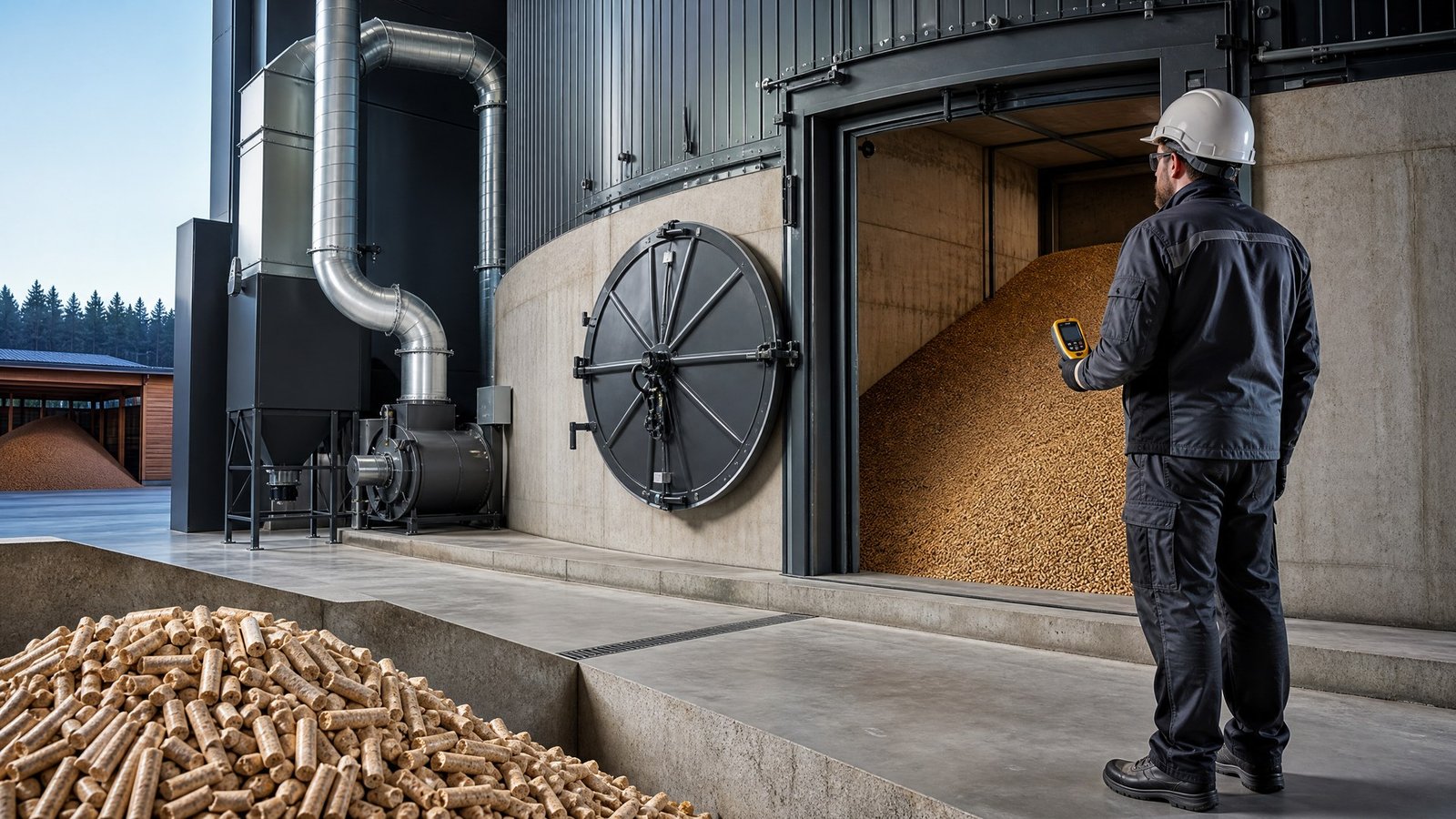
Industrial Wood Pellet Storage Safety: CO, Ventilation and Dust Controls
A wood-pellet store is not simply a dry room for fuel. It can combine an enclosed atmosphere, carbon monoxide (CO) off-gassing, oxygen depletion, combustible dust, powered screws or augers, bulk-material movement and restricted access. Those hazards must be managed as a system rather than as separate housekeeping issues.
This guide is written for industrial boiler operators, distributors, warehouses, terminals, maintenance teams and health-and-safety managers in the EU, EEA, United Kingdom, Switzerland and other European markets. It provides a procurement and operations framework, not a substitute for a site-specific risk assessment, national law, the storage-system designer’s instructions or competent engineering advice.
1. Start with a storage-hazard register
The UK Health and Safety Executive warns that enclosed pellet hoppers, tanks and rooms can become oxygen-depleted and can accumulate toxic CO. Its safety alert tells operators not to enter or place their head into a pellet store without the controls required for confined-space entry.[1] Austria’s Labour Inspectorate likewise requires CO risk to be controlled through ventilation and, where ventilation cannot reliably exclude the hazard, through suitable detection and written work controls.[2]
A useful register links each hazard to a trigger, a preventive control and evidence that the control is working.
| Hazard | Typical trigger or exposure point | Control question | Evidence to retain |
|---|---|---|---|
| Carbon monoxide | Enclosed store, newly filled store, warm conditions, low air exchange | Is ventilation designed, operating and maintained for this store? | Commissioning record, inspection log, alarm/test record |
| Oxygen depletion | Entry into an enclosed hopper, bunker or connected room | Is atmosphere testing part of the entry procedure? | Gas-test record and permit |
| Combustible dust | Filling, transfer, broken pellets, fines deposits | Has dust generation and hazardous-area zoning been assessed? | Explosion-risk assessment and zoning drawing |
| Ignition sources | Electrical equipment, hot surfaces, sparks, static discharge, hot work | Are ignition sources excluded or controlled for the classified zone? | Equipment register, inspection and hot-work permit |
| Mechanical movement | Augers, screws, gates and conveyors | Is positive isolation and lockout required before intervention? | Isolation record and permit |
| Engulfment or collapse | Entry onto or beside bulk material | Is entry prevented, or controlled with a rescue-capable system? | Entry method, supervision and rescue plan |
| Moisture ingress | Leaks, condensation, wet delivery interface | Is the store protected against water and is damaged product segregated? | Building inspection and incident record |
| Fire or self-heating indication | Odour, heat, smoke, abnormal gas reading | Is there a site-specific response that avoids unsafe disturbance of the store? | Emergency procedure and drill record |
The register should include adjacent rooms and connected openings. Directive 1999/92/EC requires explosion risks to be assessed overall, including places connected to an area where an explosive atmosphere may occur.[3]
2. Treat CO as an invisible storage hazard
CO is colourless, odourless and tasteless. The HSE explains that it can be generated by auto-oxidation reactions in stored pellets and that enclosed storage can also become oxygen-depleted.[1] Ireland’s Health and Safety Authority advises employers to assume that CO may be present wherever wood pellets are transported or stored, to identify every storage location, restrict unauthorised access and implement a written safe system of work.[4]
Freshness, temperature, exposed surface area and abrasion can affect off-gassing, so a store should not be considered safe merely because a previous reading was low or because the pellets look normal.[1] The operating rule should be simple: absence of smell is not evidence of a safe atmosphere.
A competent design should address the store itself and any space into which gas could migrate. Ventilation must be selected for the actual size, geometry, filling arrangement and national requirements. The Austrian Labour Inspectorate distinguishes controls by storage size and requires CO detectors where ventilation does not reliably eliminate the risk.[2] This article therefore does not propose one universal air-change rate or alarm threshold.
3. Control access before controlling entry
Routine access should be designed out wherever reasonably practicable. Inspection ports, remote level indication, external sampling points and maintainable equipment layouts can reduce the need to enter a bunker or hopper.
The HSE and HSA both state that personnel should not enter a pellet store, tank or vessel unless they are trained and competent in the required confined-space precautions.[1] [4] Where entry is genuinely necessary, a written permit should confirm the following before work begins.
| Permit gate | Required confirmation |
|---|---|
| Scope | The exact task, location, duration and people are identified |
| Isolation | Augers, screws, valves and other moving equipment are stopped, isolated and secured against restart |
| Atmosphere | The store is ventilated and CO and oxygen are tested with suitable equipment |
| Monitoring | The need for continuous or repeated testing is defined by the risk assessment |
| Supervision | A competent person authorises the work and appropriate attendance is maintained |
| Communication | Reliable communication between entrant and attendant is available |
| Rescue | A practicable rescue plan, trained people and equipment are ready before entry |
| Reinstatement | Guards, interlocks and ventilation are checked before the store returns to service |
A rescue plan must not depend on an unprotected colleague entering the same hazardous atmosphere. The Irish alert emphasises that CO cannot be identified without specialist equipment and that maintenance during blockages or low pellet levels requires particular care.[4]
4. Separate the CO assessment from the dust-explosion assessment
CO toxicity and combustible-dust explosion are different hazards. Ventilation intended to control gas does not automatically resolve dust ignition, and ATEX-rated equipment does not prove that the atmosphere is safe to breathe.
Under Directive 1999/92/EC, the employer must assess the likelihood and persistence of an explosive atmosphere, potential ignition sources—including electrostatic discharge—process interactions and the scale of possible effects. The required hierarchy is to prevent an explosive atmosphere, avoid ignition where prevention is not possible and mitigate harmful effects.[3]
For combustible dust, hazardous areas may be classified as Zones 20, 21 or 22 according to how frequently and for how long an explosive dust cloud may be present.[3] The European Commission distinguishes the workplace duties in Directive 1999/92/EC from Directive 2014/34/EU, which covers equipment and protective systems placed on the market for use in potentially explosive atmospheres.[5]
A practical explosion-control file should therefore document:
| Topic | Site-specific decision |
|---|---|
| Dust data | Which representative dust or fines data support the assessment? |
| Release points | Where can fines become airborne during filling, transfer or maintenance? |
| Zoning | Which locations, if any, are Zones 20, 21 or 22? |
| Ignition control | Which electrical, mechanical, hot-surface, static and hot-work sources are controlled? |
| Equipment | Is equipment suitable for its zone and maintained by competent personnel? |
| Housekeeping | How are deposits removed without creating a suspended dust cloud? |
| Protection | Are isolation, venting, suppression or containment measures required by the design? |
| Change control | When must the assessment be reviewed after equipment, process or fuel changes? |
HSE guidance on combustible dusts identifies wood among materials capable of producing combustible clouds and addresses prevention and mitigation of dust explosions and fires.[6] Final controls should be specified by competent explosion-safety professionals using actual site and material data.
5. Make filling and transfer a controlled operation
Filling changes the store’s atmosphere and can create dust, static and pressure effects. Before a delivery begins, the receiving team should confirm that the correct connection is identified, ventilation is available, access is restricted and the store has sufficient usable capacity. The driver and site representative should agree the filling sequence, stop conditions and communication method.
During transfer, people should remain outside restricted areas and abnormal dust escape, hose movement, pressure, noise or equipment behaviour should trigger a controlled stop. After filling, the site should record the lot, time, quantity, storage location, operator observations and any alarm or deviation. These records connect the material in the store to the purchasing and acceptance documents without replacing the separate delivery-acceptance procedure.
6. Keep the store dry and the product segregated when damaged
ISO 20023:2018 covers safe handling and storage in residential and other small-scale applications and expressly addresses fire, dust explosion, off-gassing, oxygen depletion and damage caused when pellets swell.[7] Its small-scale scope should not be overextended to an industrial silo, but the hazard categories remain useful prompts for industrial risk assessment.
Water ingress can change pellet condition, cause swelling and interfere with discharge or feeding equipment. Roofs, walls, service penetrations, filling connections and drainage should therefore be inspected. Wet, visibly degraded or contaminated material should be segregated and assessed under a written procedure rather than blended automatically with conforming stock.
7. Build a daily operating checklist
A daily or shift-based check should be short enough to use and precise enough to reveal deterioration.
| Checkpoint | Yes/no question |
|---|---|
| Access | Are doors, hatches and restricted-area controls secure? |
| Warning | Are CO, oxygen-deficiency, no-smoking and moving-equipment warnings visible? |
| Ventilation | Is the designed ventilation operating and unobstructed? |
| Detection | Are fixed or portable gas instruments within inspection/calibration status? |
| Dust | Are deposits, leaks or unusual fines visible at transfer points? |
| Ignition | Are hot work, smoking and unauthorised electrical devices excluded? |
| Mechanical | Are guards, interlocks and auger controls intact? |
| Moisture | Is there any leak, condensation or wet product indication? |
| Alarm | Have CO, temperature, fire or equipment alarms occurred since the last check? |
| Record | Has the check and any corrective action been logged? |
The checklist is an operating control, not proof that the design is adequate. Alarm set points, inspection frequency and calibration intervals must come from the site assessment, manufacturer instructions and applicable national rules.
8. Plan emergencies before the alarm
The emergency plan should identify who stops filling and conveying equipment, who raises the alarm, where people assemble and which information is given to emergency services. A suspected toxic atmosphere, smouldering material or silo fire requires a response designed for that scenario; unplanned opening, entry or material disturbance can expose workers or worsen conditions.
Warning signs should be readable when the access door is open as well as closed. The HSE recommends warnings for CO poisoning, oxygen deficiency, unauthorised entry, smoking and naked flames, ventilation before entry and moving parts.[1]
Training should include the difference between a CO alarm, a dust/fire event and a mechanical blockage. Workers and contractors must know that retrieving a collapsed person without appropriate protection can create additional casualties.
9. Put storage safety into the RFQ
Storage safety starts before the order is placed. A buyer can ask suppliers for lot identification, packaging or delivery format, safety information, filling instructions, expected documentation and a technical contact. The buyer remains responsible for the site design and workplace controls.
| RFQ field | Buyer wording to consider |
|---|---|
| Delivery format | State bulk or Big Bag and the permitted unloading interface |
| Lot identification | Require a delivery note and traceable lot or batch reference |
| Safety information | Request current handling and storage safety information |
| Product condition | Define agreed moisture, fines and visible-contamination criteria |
| Filling protocol | Attach site connection, communication and stop rules |
| Site limits | State maximum delivery quantity and usable storage capacity |
| Incident contact | Identify supplier and buyer contacts for deviations or damaged product |
| Acceptance link | Reference the separate sampling, COA and lot-release procedure |
10. Applying the checklist to Nord Panels enquiries
Nord Panels manufactures its wood products in Petropavlovsk, Kazakhstan, using exclusively raw materials sourced in Kazakhstan. The live wood pellets product page presents Big Bag solutions for industrial and wholesale supply and describes the pellets as made from 100% natural raw material.
Buyers can use the storage-safety questions above when defining their receiving and storage interface. The final store design, ventilation, gas detection, ATEX assessment, entry procedure and emergency plan remain site-specific responsibilities and should be completed by competent specialists under the applicable national rules.
To discuss delivery format, lot documentation and the information available for a proposed shipment, use the Nord Panels contact page. This article does not claim that Nord Panels holds a certification that is not shown on the live product page.
References
[1] UK Health and Safety Executive — Risk of carbon monoxide release during the storage of wood pellets
[2] Austrian Labour Inspectorate — Carbon monoxide during storage of wood pellets and agricultural products
[3] EUR-Lex — Directive 1999/92/EC on explosive atmospheres at work
[4] Ireland Health and Safety Authority — Wood pellets: toxic carbon monoxide poisoning
[5] European Commission — Equipment for potentially explosive atmospheres (ATEX)
[6] UK Health and Safety Executive — Safe handling of combustible dusts (HSG103)
[7] ISO 20023:2018 — Solid biofuels: safety of solid biofuel pellets, safe handling and storage